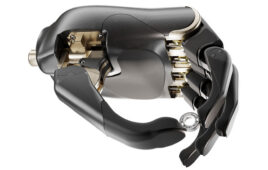
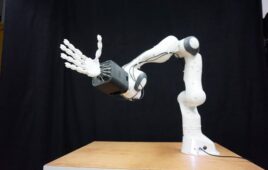
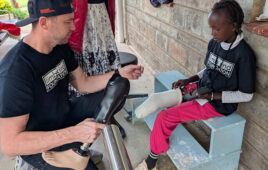
A patient controls a prosthetic arm and hand using Blue Arbor’s RESTORE Neuromuscular Interface System. [Photo courtesy of Blue Arbor Technologies]
The first RESTORE (Reimagining Engineering Solutions To Optimize Restoration of Extremities) ESU was implanted in a patient at the Medical University of Vienna in December 2025. Within days of the system’s electrodes being placed in multiple targeted muscle reinnervation sites, the patient demonstrated functional use of the system with a prosthetic limb, the company said in a news release.
“The RESTORE System is about restoring intuitive, volitional movement — not asking patients to adapt to technology, but designing technology that adapts to human biology,” Blue Arbor CEO Tod Borton said while announcing the latest from his company.
Blue Arbor designed its RESTORE Neuromuscular Interface System (NIS) to give patients more control over state-of-the-art prosthetics with its implanted electrodes.The system amplifies a limb-loss patient’s nerve signals using electrodes implanted in muscle grafts attached to the end of a peripheral nerve.
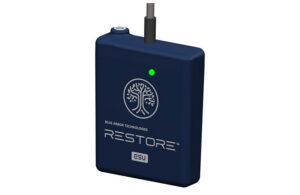
Nerve signals, amplified by internal RESTORE electrodes, are processed by Blue Arbor’s wireless External Sensing Unit (ESU). [Image courtesy of Blue Arbor Technologies]
“What makes this technology remarkable is how quickly patients can translate intent into movement,” said Dr. Oskar Aszmann, the director of the Christian Doppler Laboratory for Restoration of Extremity Function at the Medical University of Vienna, in a news release. “We are seeing control that feels more natural and responsive than anything currently available, which has profound implications for patient independence and quality of life.”
Blue Arbor says the RESTORE ESU will be its first product, describing it as “a small, wearable device connected to fine percutaneous wires [that] accurately collects biological motor commands and sends them to a receiver within the prosthetic hand.”
“In this manner, the ESU allows for intuitive prosthetic control capable of producing simultaneous individual finger and wrist movements,” the company continued.
An arm band secures the ESU and wires to the patient during use.
The company says early feasibility human trials for the system have demonstrated stable, high-quality motor signal capture for more than five years.
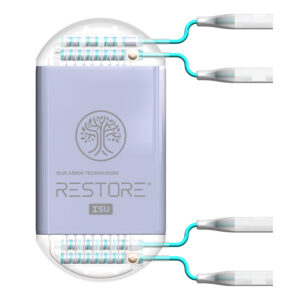
Blue Arbor is developing an internal sensing unit that would be a fully implantable prosthetic interface system. [Image courtesy of Blue Arbor Technologies]
Ottobock is the lead investor in Blue Arbor’s Series A round and a strategic partner in advancing the technology’s clinical validation, product development and commercial readiness.
“Blue Arbor’s neuromuscular interface represents a highly promising innovation for the next technological leap in prosthetic control — one that aligns perfectly with our mission to enhance human mobility through meaningful innovation,” said Ottobock CEO Oliver Jakobi.
Blue Arbor declined to disclose how much it has raised through the round or how much it wants to raise.
Read more about the Ottobock partnership at MassDevice.