Medical Design and Outsourcing

  • Home
  • Medical Device Business
    • Mergers & Acquisitions
    • Financial
    • Regulatory
  • Applications
    • Cardiovascular
    • Devices
    • Imaging
    • Implantables
    • Medical Equipment
    • Orthopedic
    • Surgical
  • Technologies
    • Supplies and Components Index
    • Contract Manufacturing
    • Components
    • Electronics
    • Extrusions
    • Materials
    • Motion Control
    • Prototyping
    • Pumps
    • Tubing
  • MedTech Resources
    • Medtech Events in 2026
    • The 2026 Medtech Big 100
    • Medical Device Handbook
    • MedTech 100 Index
    • Subscribe to Print Magazine
    • DeviceTalks
    • Digital Editions
    • eBooks
    • Educational Assets
    • Manufacturer Search
    • Podcasts
    • Webinars / Digital Events
    • Whitepapers
    • Voices
    • Views
    • Video
  • 2026 Leadership
    • 2025 Winners
    • 2024 Winners
    • 2023 Winners
    • 2022 Winners
    • 2021 Winners
  • Women in Medtech
  • Advertisers
    • Advertise
    • PR Submissions
    • Eblast Submissions
  • Subscribe

Propofol Discovery May Help Lead To Development Of New Anesthetics

September 25, 2013 By AxoGen, Inc.

eNw research on the most commonly used anaesthetic drug could help to unravel a long-standing mystery about how it induces a pain-free, sleep-like state.

General anaesthetics are administered to tens of millions of people every year in hospitals, where they are used to sedate patients undergoing surgery. Despite this, scientists have yet to understand how the drug interacts with its targets in brain cells to achieve this effect.

Following years of research on propofol, which has become the most commonly used anaesthetic since it was introduced in the 1980s, researchers at Imperial College London and Washington University School of Medicine have published a study in the journal Nature Chemical Biology in which they identify exactly how the drug acts at a molecular level.

Researchers had already identified the receptor that propofol interacts with in the brain. Having a more detailed picture of exactly how propofol works in the brain may help scientists to design new versions of the drug that reduce the risks involved in surgery and ultimately improve patient safety.

Propofol has also become widely known as the drug linked to the death of superstar Michael Jackson in 2009.

“The job of the skilled anaesthetist is so important because in addition to the desirable effects of anaesthetics which make surgery possible, current anaesthetics can have unwanted effects on the heart, on blood pressure and can also interfere with breathing during surgery,” said the study’s co-principal investigator Professor Nick Franks from the Department of Life Sciences at Imperial College London.

“Whilst propofol is the best anaesthetic we have today, it is important for patient safety that we come up with new versions of the drug that work just as well or better as anaesthetics, but have fewer or less dangerous side effects.”

“For many years, the mechanisms by which anaesthetics act have remained elusive,” explained co-principal investigator Alex S Evers, MD, the Henry E. Mallinckrodt Professor and head of the Department of Anesthesiology at Washington University.

“We knew that intravenous anaesthetics, like propofol, act on an important receptor on brain cells called the GABAA receptor, but we didn’t really know exactly where they bound to that receptor.”

In an attempt to understand how propofol induces anaesthesia during surgery, scientists have tried to identify how and where it interacts with receptors in the brain called gamma-aminobutyric acid type A (GABAA) receptors. Activating these receptors — with propofol for example — stops a nerve cell communicating with its neighbours, leading to unconsciousness.

For this study, the scientists created a molecule that closely resembles and mimics propofol but has an added hook that grabs onto the GABAA receptor and won’t let it go when it is activated by a bright light. They then extracted the receptor, cut it into pieces and identified the place on the protein that the propofol mimic had attached to.

Using the techniques they have developed, the scientists say they will now identify binding sites of other anaesthetics. They believe their approach also can be used to study other types of drugs, such as psychiatric agents and anti-seizure drugs.

Related Articles Read More >

MIT spinout develops hydrogel bioadhesive inspired by barnacles and spiders 
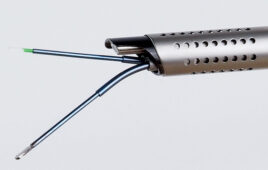
The Virtuoso System endoscope tip with manipulators,
Tiny, superelastic nitinol arms make this breakthrough surgical robot possible
An illustration showing the Autus size-adjustable heart valve being expanded years after implantation with a minimally invasive balloon catheter.
The first-of-its-kind Autus pediatric heart valve is designed for expansion and durability
J&J EP leader Michael Bodner offers a PFA program update
“mdo
EXPAND YOUR KNOWLEDGE AND STAY CONNECTED
Get the latest medical device business news, application and technology trends.

DeviceTalks Weekly

See More >

MDO Digital Edition

Digital Edition

Subscribe to Medical Design & Outsourcing. Bookmark, share and interact with the leading medical design engineering magazine today.

MEDTECH 100 INDEX

Medtech 100 logo
Market Summary > Current Price
The MedTech 100 is a financial index calculated using the BIG100 companies covered in Medical Design and Outsourcing.

New MedTech Resource

Medical Tubing

MassDevice

Mass Device

The Medical Device Business Journal. MassDevice is the leading medical device news business journal telling the stories of the devices that save lives.

Visit Website
MDO ad
Medical Design and Outsourcing
  • MassDevice
  • DeviceTalks
  • MedTech100 Index
  • Medical Tubing + Extrusion
  • Medical Design Sourcing
  • Drug Delivery Business News
  • Drug Discovery & Development
  • Pharmaceutical Processing World
  • R&D World
  • About Us/Contact
  • Advertise With Us
  • Subscribe to Print Magazine
  • Subscribe to our E-Newsletter
  • Listen to our Weekly Podcasts
  • Join our DeviceTalks Tuesdays Discussion

Copyright © 2026 Arrowfly, LLC. All Rights Reserved. The material on this site may not be reproduced, distributed, transmitted, cached or otherwise used, except with the prior written permission of Arrowfly LLC. Site Map | Privacy Policy | RSS

Search Medical Design & Outsourcing

  • Home
  • Medical Device Business
    • Mergers & Acquisitions
    • Financial
    • Regulatory
  • Applications
    • Cardiovascular
    • Devices
    • Imaging
    • Implantables
    • Medical Equipment
    • Orthopedic
    • Surgical
  • Technologies
    • Supplies and Components Index
    • Contract Manufacturing
    • Components
    • Electronics
    • Extrusions
    • Materials
    • Motion Control
    • Prototyping
    • Pumps
    • Tubing
  • MedTech Resources
    • Medtech Events in 2026
    • The 2026 Medtech Big 100
    • Medical Device Handbook
    • MedTech 100 Index
    • Subscribe to Print Magazine
    • DeviceTalks
    • Digital Editions
    • eBooks
    • Educational Assets
    • Manufacturer Search
    • Podcasts
    • Webinars / Digital Events
    • Whitepapers
    • Voices
    • Views
    • Video
  • 2026 Leadership
    • 2025 Winners
    • 2024 Winners
    • 2023 Winners
    • 2022 Winners
    • 2021 Winners
  • Women in Medtech
  • Advertisers
    • Advertise
    • PR Submissions
    • Eblast Submissions
  • Subscribe