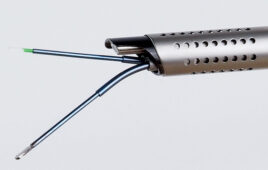
The investigational Sentante Stroke System includes a robotic bedside unit for performing remote thrombectomies on acute ischemic stroke patients. [Image courtesy of Sentante]
The stroke telesurgery platform will have applications beyond interventional neurology, Sentante co-founder and CEO Edvardas Satkauskas said in a Medical Design & Outsourcing interview while offering insight into where the endovascular robotics field is headed and what technologies are needed to get it there.
Sentante designed its system for remote delivery and manipulation of endovascular devices for thrombus removal in intracranial vessels for patients with acute ischemic stroke. The company joined the FDA Total Product Life Cycle Advisory Program (TAP) in February 2026 after earning Breakthrough Device designation.
The following has been lightly edited for length and clarity.
MDO: What are you working on for the next generation of this device? Are there other applications you think are viable in the near or distant future?
Satkauskas: “In the near future, the focus is advancing toward first-in-human remote stroke trials and progressing regulatory clearance for peripheral vascular applications. Next-generation development includes increased automation assistance features, enhanced data capture for training and performance optimization, and greater workflow integration. Beyond stroke, the platform is applicable across peripheral vascular and neurovascular, soon expanding the offering to support cardiovascular interventions. The core architecture is multi-utility by design.”
Related: Sentante’s breakthrough telesurgery system could redefine stroke care
Where is the endovascular surgical robotics field headed next? What technologies do you need to get it there?
Satkauskas: “Sentante is redefining the paradigm of interventional medicine by transforming it from a hands-on craft limited by location into a universally accessible data-driven science, powered by intelligent robotics. So the easiest way to understand what’s next is to look where the data travels.
“We’re now entering commercialization in the EU through peripheral vascular surgery. Sentante is a data hub transforming manual procedures into digital and collecting digital procedure data for next steps in development.

Sentante’s remote workstation includes guidewire and catheter controls and live imaging. [Photo courtesy of Sentante]
“The core bottleneck for physical AI in medicine is the data, not the AI engine. AI today is effectively a brain without hands, and more importantly, without eyes. It has no way to sense, interpret, or learn from the physical world of a procedure: the resistance and dynamics of devices inside a blood vessel, and how an expert physician manipulates those devices to achieve a clinical goal.
“Sentante’s robotic platform digitizes exactly that. Every procedure generates a continuous stream of haptic, kinematic and imaging data that maps expert physician skill into a structured, replayable training signal.
“That dataset doesn’t exist anywhere today. It can only be created through clinical use of a system like ours. Moreover, Sentante’s haptic manual-like interface enables imitative learning, and expert skills are replicated 1:1. We don’t need to train doctors to work with the robot; doctors will train the robot while using it. Sentante has built the sensory and mechanical infrastructure that makes future autonomy trainable. The robot is the data collection device. The data is the moat.”
Related: Lessons learned and FDA TAP tips from Sentante
Why is this technology important now?
Satkauskas: “Endovascular medicine desperately needs new technologies that would address unmet clinical needs, but it still remains the only major surgical domain without a commercially dominant robotic platform.

Sentante CEO Edvardas Satkauskas [Photo courtesy of Sentante]
“The access crisis means long waiting lists, limited 24/7 service and geographical disparities for critical emergencies like stroke, ultimately translating into tremendous cost for the healthcare systems across the globe.
“The hospital efficiency crisis has growing healthcare costs and limited ways to improve resource efficiency and clinical outcomes.
“The digital and robotic transformation is not just about bringing cool technology to the hospital. It is about access to life-saving care, efficiency, safety and long-term workforce sustainability. It addresses a growing gap in care that costs lives and independence every day, and we believe it has the potential to redefine how time-critical vascular care is delivered worldwide.”
Read our July 2026 surgical robotics issue of MDO magazine for more about the stroke telesurgery race and keep up on the latest developments by subscribing to our newsletter. You can also read more about innovative surgical robotics companies in our latest special report.