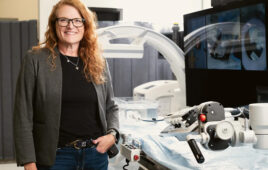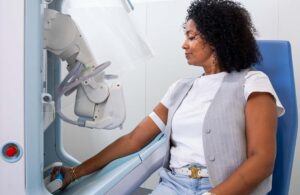
Vitestro’s Aletta device uses AI-guided multimodal imaging to identify suitable veins for blood collection. [Photo courtesy of Vitestro]
FDA granted de novo classification for Vitestro’s Aletta system in August 2026, calling it an “innovative approach to blood collection” that could help address a critical public health need.
“Blood draws are one of the most commonly performed medical procedures in the United States, yet patients may face delays due to a growing shortage of trained phlebotomists,” FDA Center for Devices and Radiological Health Director Dr. Michelle Tarver said when announcing the regulatory milestone.
As demand for phlebotomists grows, Vitestro expects capacity issues to intensify and impact patients’ access to blood testing. Vitestro designed Aletta to ease the burden on phlebotomy labs through standardization by combining robotics, artificial intelligence, multimodal imaging and Doppler ultrasound to collect blood samples with precision and consistency.
The company already has support from Mayo Clinic, Labcorp Venture Fund and Sonder Capital co-founder Dr. Fred Moll, who also co-founded medical robotics leader Intuitive Surgical.
“Vitestro is redefining one of the largest and most under-innovated clinical workflows with a first-of-its-kind autonomous robotic platform for diagnostic blood collection addressing an enormous unmet global market need,” Moll said when Vitestro closed its $70 million Series B funding round in March 2026. “I believe this technology has the potential to establish a new standard of care, much as robotic surgery did in its early days.”
How Aletta works
The Aletta system’s process is described in documents from the company, the FDA and a premarket clinical study.
After a draw order is manually determined by a supervising professional, Aletta’s work begins with a patient inserting labeled blood collection tubes into the device. The system picks up a bandage and a 21-gauge, single-use blood collection set.
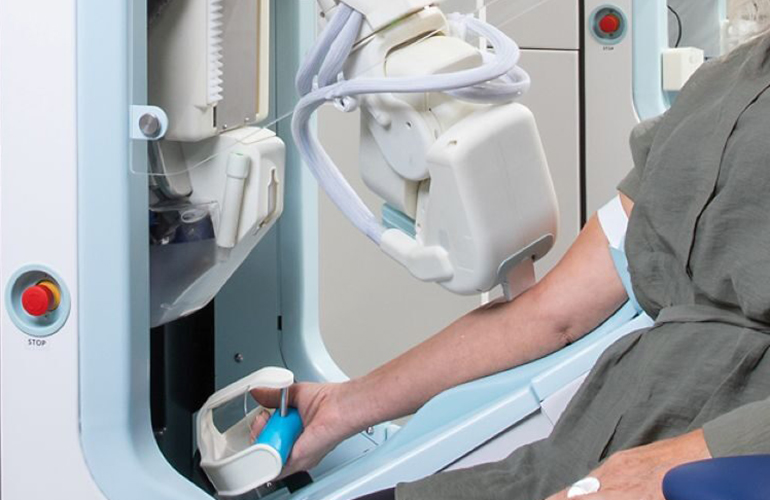
Throughout Aletta’s blood draw procedure, a supervising healthcare professional is required to be nearby to address any issues. Two red emergency “stop” buttons for safety are pictured here. [Photo courtesy of Vitestro]
Aletta first identifies a starting position for the ultrasound probe using near-infrared imaging and sprays 70% alcohol on the skin. The system scans the patient’s antecubital area with ultrasound to find a suitable vein. Once Aletta identifies a vein, it uses Doppler ultrasound to distinguish the vein from an artery and applies tourniquet pressure.
Aletta analyzes vein size, depth and orientation before the needle is inserted. If the system doesn’t find a suitable vein, it won’t attempt the blood draw. If the vein meets Aletta’s criteria, the needle is inserted at an angle between 10° and 30° with what Vitestro describes as “standardized insertion speed.”
Collection tubes are connected for filling after needle insertion. Each sample is inverted immediately after filling for a predefined number of times.
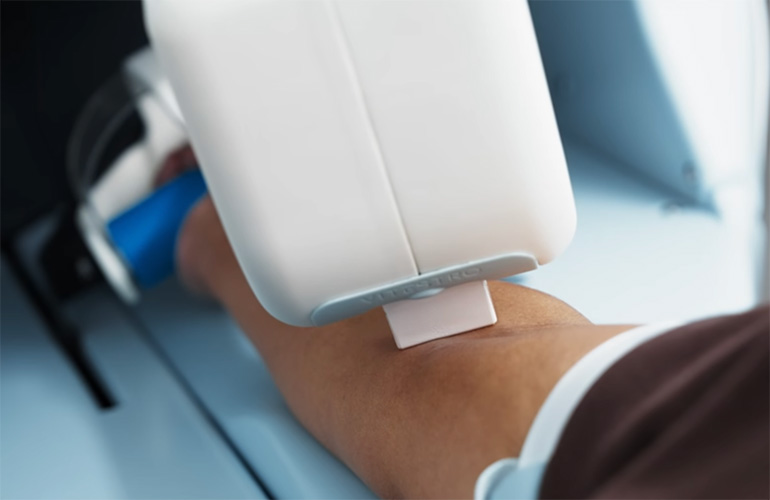
The needle is hidden from the patient’s view during the draw. [Photo courtesy of Vitestro]
Once all collection tubes are filled or the draw is stopped, the needle is removed and the puncture site is compressed with a bandage. The blood samples are stored in the device at room temperature, and the patient leaves.
Aletta’s median procedure time from initiation to completed bandage application was 2 minutes and 37 seconds, according to the trial data.
Related: Read more about robotics in MassDevice’s 2026 Surgical Robotics Special Report
Promising trial results
FDA said Aletta’s de novo classification was based on clinical data that showed it “achieves successful blood draw rates comparable to or better than trained human phlebotomists.”
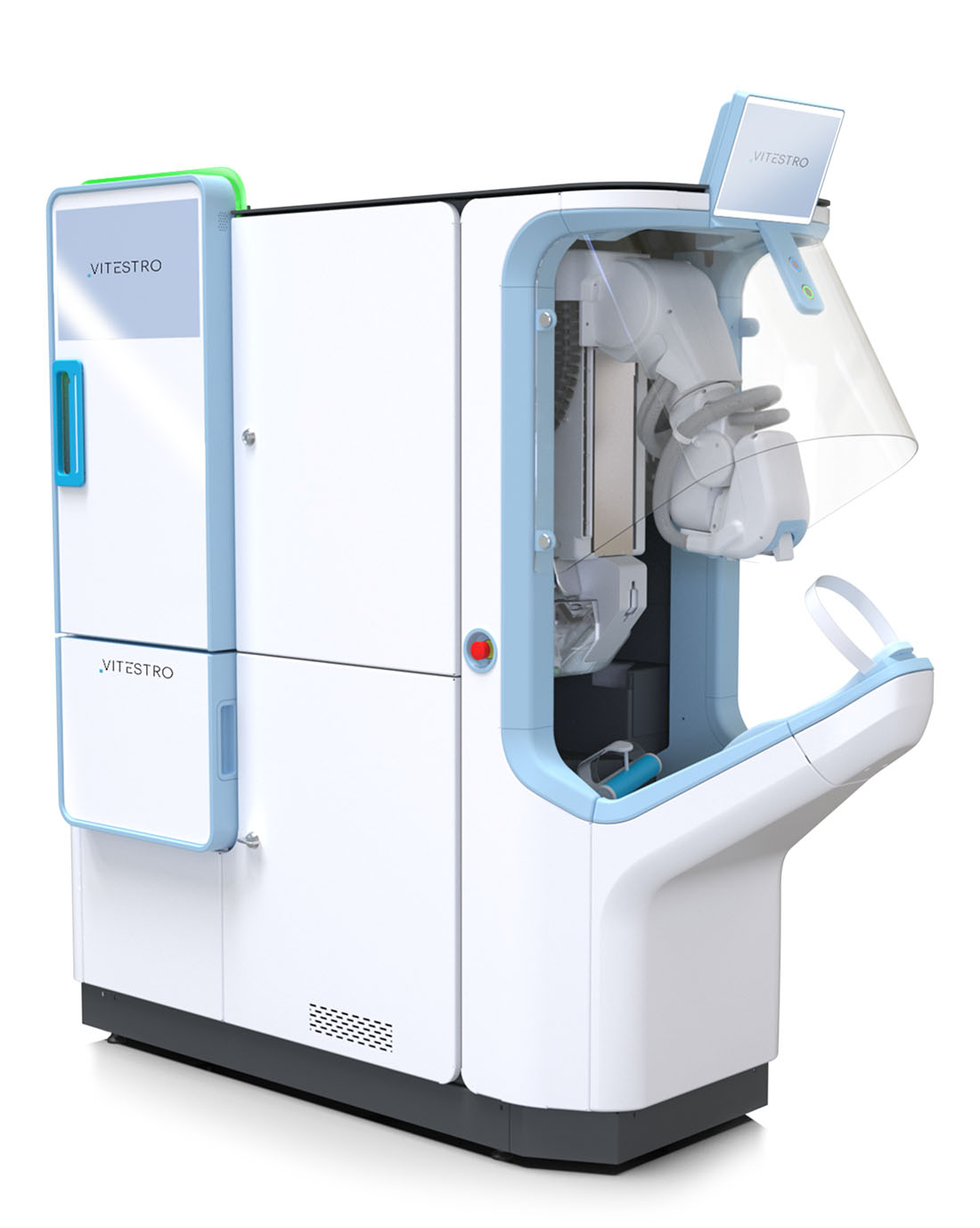
One supervising healthcare professional can manage three Aletta autonomous blood draw devices at the same time, Vitestro says. [Photo courtesy of Vitestro]
The first cohort tested analytical equivalence in lab results from samples taken by a phlebotomist compared with samples taken by Aletta. Through this, Vitestro wanted to assess the device’s set automated inversion number — nine inversions per sample, across various FDA-cleared tube brands — compared to manual samples inverted between four and 10 times according to manufacturer instructions.
“The main risk of excessive inversions is mechanical stress on erythrocytes, which can induce hemolysis,” the study protocol said. “Therefore, the validation assessed whether additional standardized inversions affected sample quality.”
The results showed no statistically significant differences in the results between the Aletta samples and the manually collected samples, suggesting that the device’s standardized number of automated inversions across blood collection tubes did not affect test outcomes.

Vitestro co-founders Brian Joseph (left) and Toon Overbeeke (right) [Photo courtesy of Vitestro]
The second cohort evaluated Aletta’s first-stick rate and adverse effects across a broad range of patients with various health statuses, patients who self-reported having difficult veins to access and patients with a variety of skin tones.
Aletta demonstrated an overall first-stick success rate of 95% and no serious adverse events in 1,633 participants. The first-stick success rate was 93% in patients with difficult venous access and 97% in obese patients. The company attributed its success rate to the use of ultrasound-guided vein detection, which finds deeper, less palpable veins.
“Equally important is how patients experience the procedure,” said Martine Deckers, another of the study’s authors. “In this study, most patients reported less or similar pain compared with a manual draw, and almost all patients indicated they would prefer or be open to using the system again, supporting its potential for broader adoption in routine clinical practice.”
Watch on-demand: The 2026 MDO Min-Vasive Medtech webinar series