Placing a central venous catheter, or a central line, in patients is a common procedure for physicians, but not an easy one. In fact, mistakes happen up to 10 percent of the time and cost U.S. hospitals an estimated $4.5 billion each year.
With its Ballistra Guidewire Advancer, the Acantha Medical team – made up of Yale students and faculty – hopes to eliminate many of those complications and make the procedure much safer. In less than two years, the start-up has attracted a number of investors and accolades. Most recently, it won a $15,000 prize from the National Institute of Biomedical Imaging and Bioengineering and VentureWell.
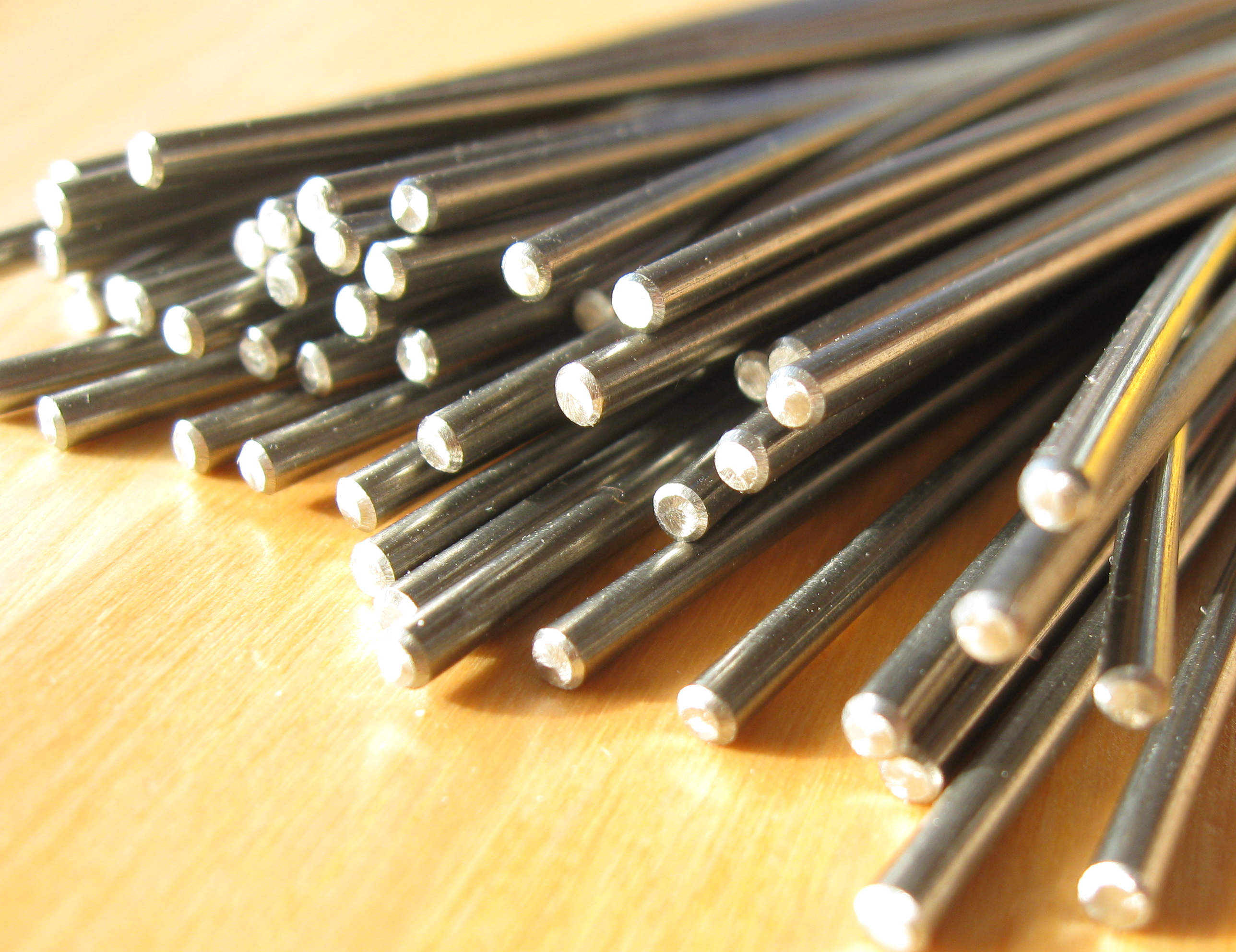
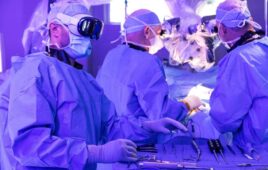
The device is designed to simplify what can be a tricky procedure. Physicians place central lines to administer medicines, fluids, nutrients, or blood products over a long period of time, but the process is complicated. Among other steps, the clinician sticks a needle in a large vein of a patient’s neck, chest, or groin; threads a wire through the needle into the vein; removes the needle, and then uses the wire to deliver a plastic tube (the “central line”) into the vein. A handheld ultrasound image is used to guide the needle’s placement, but must be put down for steps that require a switch of hands.
“At that point, you can’t see the needle while it’s inside,” said Andres Ornelas-Vargas ’17, a biomedical engineering major and one of the company’s principals. “What’s so crazy is that we’ve been doing this procedure the same way since 1959.”
In the time the clinician picks up the ultrasound again, things could go very wrong.
“The needle can lose access to the vein, puncture through the vein to the adjacent artery, or even go into the lung,” said Brandon Hudik ’17, a mechanical engineering major and another member of the Acantha team.
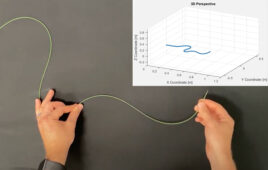
The Acantha team’s device allows the user to insert the guidewire with one hand and continuously monitor the location of the needle tip via ultrasound. It simplifies the procedure to a few thumb movements and allows full visibility of the guidewire at all times.
The device evolved out of discussions between Ornelas-Vargas and Jason Chin, a vascular surgery resident at the Yale School of Medicine, about the central line procedure and why nothing had been done to improve it. They drew sketches on napkins and brainstormed. Like Ornelas-Vargas, Hudik worked late at nights at the Klingenstein Design Lab at the Center for Engineering Innovation & Design (CEID), and he soon joined the team. Another member of the Acantha team is Dr. Steven Tommasini, who had earlier worked with Ornelas-Vargas on different medical device and took on the role of faculty advisor for the Ballistra project. Juan Pablo Arroyo, a former postdoctoral researcher in Yale’s genetics department (now an internal medicine and nephrology resident at Vanderbilt) also serves as advisor.
Besides helping with the design, Chin has tested the device himself and recruited other clinicians to try it. About 30 health professionals of varying specialties have tested the device at the Yale School of Medicine and the Yale Center for Medical Simulation. The team has received overwhelmingly positive response.
“The doctors love to be able to do multiple tests with one hand and not have to switch hands while there’s a needle in the vein of a patient,” said Tommasini, assistant professor of orthopedics & rehabilitation and biomedical engineering. “That makes the process safer and faster, especially for less experienced clinicians.”
“The device is extremely intuitive to use and could have a huge clinical impact,” said Joseph Zinter, assistant director of the CEID. Zinter helped to advise Hudik while he worked on Ballistra during his CEID summer fellowship.
Getting feedback from the health professionals has been critical to the design’s evolution. The team estimates that they’ve developed 40 iterations of the prototype. These were made with 3D printers at the CEID where the resources and staff have been a major factor in advancing the project, especially when the team was operating on a lean budget.
They have also been working with mentors from the School of Management and other business managers in marketing the product. Their goal is either to sell the Ballistra Guidewire to an existing company, or move forward on their own.
This fall, the team has its work cut out for them, as it plans to expand testing, get price estimates for injection-molded manufacturing and work with regulatory consultants on getting their product classified as a Class 2 Medical device. And they will continue tweaking their prototype.
“There are always things to improve,” Ornelas-Vargas said.