MIT researchers have demonstrated a low-cost design of specialized electronic nozzles, called triaxial electrospray emitters (pictured here), that could be used to manufacture time-release drug-delivery particles or self-healing materials. [Image courtesy of the researchers]
The nozzles, called triaxial electrospray emitters, use electricity to precisely dispense three liquids. This generates a steady steam with three distinct fluid layers. The liquid forms multilayered droplets, which can solidify into layered microparticles.
According to MIT, the emitters could make three-layer drug-delivery nanoparticles. The outer layer might slowly erode in the stomach, revealing a second material that controls the release of a core material. This delivers medicine to a specific area of the intestines.
MIT researchers say that the development of these types of emitters usually requires expensive and time-consuming microfabrication processes. Such processes take place inside semiconductor cleanrooms, also limiting use.
To address this, the researchers 3D-printed arrays with 16 nozzles comprising about 1 cm². Each device has a network of 3D microchannels that supply liquid to the nozzles.
The one-step fabrication process takes just a few hours, the researchers said. Testing demonstrated uniform, three-layered droplets generated at scale.
“We couldn’t make a device like this in a semiconductor cleanroom. This is only possible because they are 3D-printed,” said Luis Fernando Velásquez-García, a principal research scientist in MIT’s Microsystems Technology Laboratories (MTL) and senior author of a paper describing this advance. “The particles these devices generate, whether they are used for a self-healing composite or to deliver medicine, can have a big impact in many applications. We want to democratize this technology so the benefits can touch many more people.”
More about the development of the MIT nozzles
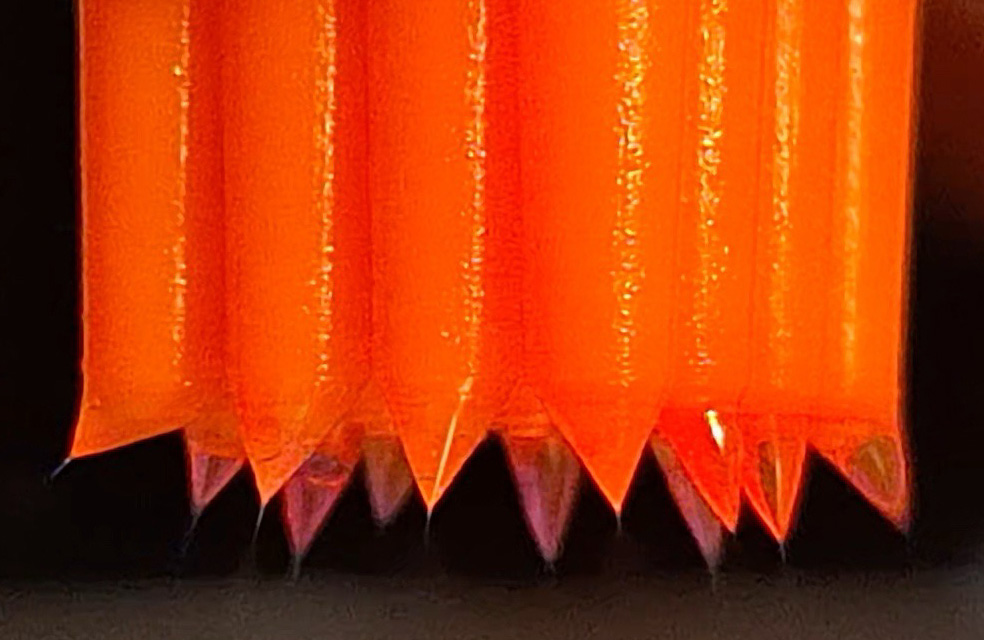
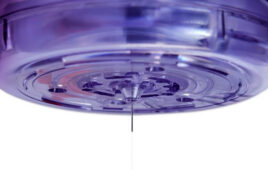
This photo offers a closer look at the nozzles that emit the three-layered microdroplets. [Photo courtesy of the MIT researchers]
The researchers say that traditional cleanroom production processes limit the shapes and sizes of device components.
“When you build a triaxial array, you need to find a way to create geometries that have many integrated parts and extremely fine structures in the smallest footprint possible. And you need to ensure the devices will work uniformly,” Velásquez-García said.
The 3D-printing technique used by the team is called vat photopolymerization. It uses light to solidify extremely thin layers of liquid resin, fabricating a complex device one layer at a time. The process allowed researchers to print layers measuring just 25 micrometers tall, a fraction of the width of a human hair, MIT says.
Slightly larger than a U.S. penny, the array features a network of internal coiled channels that carry liquid to 16 nozzles. Helical microchannels help maintain a uniform spray across all nozzles. Tiny channels without support structures needed to be fabricated so that the device wouldn’t clog, ensuring that all uncured resin was removed before using the array.
“We were able to aggressively optimize the design because we could iterate in a much timelier manner. This ability to exquisitely refine designs is a key advantage of 3D printing,” Velásquez-García said.
The researchers tested multiple architectures, finding that middle liquid viscosity plays the most important role of achieving stability in a microdroplet. This function preserves the thickness of each layer, according to MIT. The researchers also found that adjusting flow rates and voltages could precisely tailor the thickness of each microdroplet layer. That enables scientists to design drug-delivery particles with ideal layers so medicine releases at exactly the right time.
Future work includes refining the fabrication process for even smaller dimensions. The researchers also hope to integrate conductive or dielectric materials to the devices for more advanced arrays.
“By making such intricate devices more practical, we can empower others to pursue entrepreneurial and scientific advances,” Velásquez-García said.