This article is part of Qosina’s “The Engineer’s Guide” recurring series covering practical component selection guidance for medical device design engineers.
By Stephanie Alwais, Qosina

Stephanie Alwais is an applications engineer at Qosina, a global supplier of OEM single-use components for the medical and pharmaceutical industries. [Photo courtesy of Qosina]
This installment covers barbed connection tubing and the device that retains it, along with what the finished engagement must deliver in service, adequate flow and verified performance. The starting point is the tubing, because in most programs it’s specified first and everything else is selected around it.
Tubing compatibility
Fluid delivery tubing is most often flexible PVC, platinum-cured silicone, thermoplastic elastomer (TPE) or polyurethane. That choice is rarely made on the connection alone. Pumpability, weldability, kink resistance, clarity, chemical compatibility and cost all factor in, and in most programs, the tubing is selected before anyone looks at a connector. That is the right order, provided the full tubing specification travels with it.
Each material brings a different relationship with the barb. Platinum-cured silicone is soft and highly elastic, so it seals readily and tolerates high interference. It also creeps over time and tears more easily against an aggressive barb edge. TPE spans a wide durometer range depending on grade, which means a TPE callout without a durometer figure is not a specification. TPE can offer the best of both worlds. It has the flexibility to wrap around a barb, similar to silicone, while also allowing for alternative connections down the line via welding or adhesives. Flexible PVC is stiffer and holds its dimensions rather than sealing around the barb. It also carries plasticizers that can interact with the connector resin across shelf life. Polyurethane is stiffer still, with good abrasion and kink resistance, and it leans more heavily on a retention device to hold the engagement.
Beyond material, three properties determine how the connection performs, and all three shift over shelf life:
- Durometer sets the interference target. Softer tubing is more forgiving of barb geometry and seals more readily. It also creeps more, which means the sealing force present at assembly is not the sealing force present after aging. Stiffer tubing holds its dimensions and depends more heavily on a retention device.
- ID tolerance is not tight and extruded tubing varies. Work from the tolerance band rather than the nominal number and confirm that the worst case of maximum tubing inner diameter (ID) and minimum barb outside diameter (OD) still passes leak and pull-off requirements. This is application-dependent and must be tested for each engagement.
- Wall thickness deserves as much attention as ID. Two tubes with the same ID and different walls are not interchangeable on the same barb. The wall generates sealing force when stretched, so a thin wall over an aggressive barb has less material available to seal and less resistance to being cut by the barb edge. A heavy wall seals harder and resists blow-off better, and it also takes more force to assemble. Wall thickness sets the OD the clamp must close on as well, which means clamp size will be different for two tubings with the same ID and different wall thicknesses.

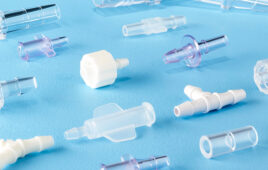
Fluid delivery tubing is most often flexible PVC, platinum-cured silicone, thermoplastic elastomer (TPE) or polyurethane. [Photo courtesy of Qosina]
Retention methods: clamp, tie or bond
Retention devices sit immediately behind the barb and improve pull-off strength and pressure resistance.
Cable ties are inexpensive and fast, and are specified by width, length, breaking strength and color. Many are distributed through industrial channels that do not operate under the controls a device manufacturer needs, which is a supplier qualification question rather than a technical one. Oetiker clamps deliver more repeatable compression than a hand-applied tie, are specified by width and diameter range, and are available in degreased formats suited to cleanroom assembly.
Permanent joining methods are often the better answer in a fluid delivery device. Solvent bonding, UV-cure adhesive, overmolding and ultrasonic welding produce an engagement that cannot be disassembled and does not depend on a clamp holding its load across shelf life. Each brings its own qualification work, including cure validation, residual solvent, adhesive extractables and sterilization compatibility. The ability to use these methods is directly related to the material choice of the tubing and connection.
The decision is not purely technical. A clamp is a discrete component with a part number, incoming inspection, traceability and its own failure mode. A bonded engagement is a validated process. The question to ask early is which of these is more worth managing, with all the associated risks.
Previously from Qosina: The Engineer’s Guide to Luer connector selection
Flow considerations: check the bore, not the label
The most common flow surprise with barbed fittings is that the connector, not the tubing, is the restriction in the line. A barb stem requires wall thickness, and that wall comes out of the bore, so a fitting labeled for 1/4-inch tubing may have a noticeably smaller internal diameter.
Laminar flow resistance scales with the fourth power of radius, so small reductions have outsized effects. Halving the effective diameter raises resistance roughly sixteenfold. In a gravity-fed set, where the driving pressure is a meter or so of head, that appears directly as a slower delivery rate.
Step changes where tubing ID meets a smaller connector bore also create stagnation zones at the shoulder. In blood-contacting applications, those zones are where clot formation begins. In drug delivery, they are where hold-up volume accumulates. Specify the largest bore and smoothest internal transition the design allows, particularly where the fluid path is shear sensitive or the flow rate is a labeled claim. Verify the rate on the assembled set rather than calculating it from tubing dimensions.

Each material brings a different relationship with the barb. [Photo courtesy of Qosina]
Design and integration considerations
A few factors that regularly surface during connector qualification:
- Pull-out force data: Published figures are useful for screening and misleading as design values. A number means nothing without the tubing material, durometer, ID and wall it was generated with; the retention device and its compression; the conditioning of the sample; and the rate the load was applied. Ask for the full test conditions alongside any figure, and most importantly, generate data on the combination you’ve chosen.
- Pressure profile: Design to the occlusion alarm threshold rather than the nominal running pressure. Pressure spikes expand tubing radially and loosen the barb’s grip, and that is the condition that finds a marginal engagement.
- Assembly force: Too much of it costs cycle time, exposes operators to repetitive strain and raises the odds of a partially seated engagement. Treat it as a design output worth measuring rather than an ergonomics footnote.
- Sterilization and aging: EtO, gamma, e-beam and steam each interact differently with connector materials, and steam can relax a barbed engagement enough to change its pull-off performance. Run leak and pull-off testing after sterilization and after accelerated aging per ASTM F1980, not only on new samples.
- Verification methods: The test methods in ISO 80369-20 were written for small-bore connectors rather than barbs, but they provide a defined framework for separation under axial load, positive pressure liquid leakage and sub-atmospheric air leakage that can be adapted rather than invented.
- Second sourcing: Because there is no dimensional standard for barbs, an alternate source is rarely a drop-in. Evaluate at qualification whether the alternate’s stem geometry is close enough to qualify against the same test protocol.
Questions to ask your supplier
Before adding a barbed connector to an approved vendor list, these questions are worth having answered in writing:
What is the actual stem diameter and internal bore, and what is the interference against the tubing ID being specified? If a CAD model for the part is available, it would help to validate the design.
Is the sealing surface of the barb free of a mold parting line, and how is that verified in production?
What pull-out force data exists, and under what tubing, retention device, conditioning and test conditions was it generated?
What are the full material constituents including additives and colorants, and is a regulatory support file available? Are any claims made with regard to elements like biocompatibility, extractables and leachables and cleanroom manufacturing?
What sterilization methods has the connector been validated for, and is there post-irradiation aging data for radiation-stabilized grades?
Is second-source availability documented, and are there dimensional differences between sources that would require separate qualification?
What comes next?
Barbed connections remain one of the most cost-effective and versatile ways to join a fluid path, and for most applications that simplicity is a feature. Interference, barb count, resin, retention method and bore are where engineering decisions really matter.
The absence of a dimensional standard for barbs is unlikely to change, which means the burden of verification stays with the engineer rather than with the specification. Treat the barb, the tubing and the retention method as one system. Start from the tubing spec, not the nominal size. Then test the combination intended for production, at the tolerance extremes and after sterilization and aging. That is the difference between a connection that only works on the bench and one that holds at the bedside.
Stephanie Alwais is an applications engineer at Qosina, a global supplier of OEM single-use components for the medical and pharmaceutical industries.
Read more MDO Contributions and learn how to submit your own.
The opinions expressed in this article are the author’s only and do not necessarily reflect those of Medical Design & Outsourcing or its employees.
Tell Us What You Think!
You must be logged in to post a comment.