Medical Design and Outsourcing

  • Home
  • Medical Device Business
    • Mergers & Acquisitions
    • Financial
    • Regulatory
  • Applications
    • Cardiovascular
    • Devices
    • Imaging
    • Implantables
    • Medical Equipment
    • Orthopedic
    • Surgical
  • Technologies
    • Supplies and Components Index
    • Contract Manufacturing
    • Components
    • Electronics
    • Extrusions
    • Materials
    • Motion Control
    • Prototyping
    • Pumps
    • Tubing
  • MedTech Resources
    • Medtech Events in 2026
    • The 2025 Medtech Big 100
    • Medical Device Handbook
    • MedTech 100 Index
    • Subscribe to Print Magazine
    • DeviceTalks
    • Digital Editions
    • eBooks
    • Educational Assets
    • Manufacturer Search
    • Podcasts
    • Webinars / Digital Events
    • Whitepapers
    • Voices
    • Views
    • Video
  • 2026 Leadership
    • 2025 Winners
    • 2024 Winners
    • 2023 Winners
    • 2022 Winners
    • 2021 Winners
  • Women in Medtech
  • Advertise
  • Subscribe

New material illuminates when exposed to chemicals on the body

February 28, 2017 By Danielle Kirsh

MIT-living-hydro_0

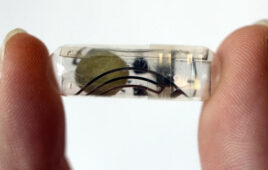
Researchers have found that the hydrogel’s mostly watery environment helps keep nutrients and programmed bacteria alive and active. When the bacteria reacts to a certain chemical, the bacteria are programmed to light up, as seen on the left. [Photo courtesy of the researchers]

MIT engineers and biologists teamed up and designed a living-cell-injected hydrogel that can illuminate when exposed to certain chemicals.

The MIT team made wearable sensors using the hydrogel with living cells that lit up after touching a surface with certain chemicals. The new material has the potential to detect chemicals in the environment and the human body.

“With this design, people can put different types of bacteria in these devices to indicate toxins in the environment, or disease on the skin,” said Timothy Lu, associate professor of biological engineering and electrical engineering and computer science, in an MIT news release. “We’re demonstrating the potential for living materials and devices.”

Lu specializes in reprogramming the biological parts of living cells to do what he wants them to do, like performing certain tasks like sensing and signaling the presence of viruses and toxins.

Xuanhe Zhao and his team of engineers at MIT have spent the past 5 years creating a combination of polymers and water to make the stretchable, biocompatible hydrogels. It contains 95% water and is able to support living cells. Zhao also recently created a robot with the hydrogels that could be used in surgical applications.

Lu and Xuanhe combined their expertise and infused Lu’s genetically programmed bacteria into Zhao’s hydrogel material. Using 3D printing, they made small channels in the first layer of the hydrogels. Then they merged the hydrogel to a layer of elastomer that could let in oxygen. The reprogrammed E. coli cells were programmed to detect the natural compound DAPG and were injected into the channels. The hydrogel material was submerged in nutrients that infused through the hydrogels and kept the bacteria alive for several days. Each channel lit up when exposed to the chemical compounds.

The team also created a bandage that had the same type of channels with bacteria that was sensitive to the naturally occurring sugar rhamnose. They swabbed a volunteer’s wrist with rhamnose and put the hydrogel bandage on the area. The bandage lit up in response to the rhamnose.

They also created a hydrogel glove with swirling channels on the fingertips that also glowed when exposed to certain chemicals.

The researchers have also supplied a theoretical model to guide other researchers who might be interested in designing living materials and devices.

“The model helps us to design living devices more efficiently,” Zhao said. “It tells you things like the thickness of the hydrogel layer you should use, the distance between channels, how to pattern the channels and how much bacteria to use”

The research was supported by the Office of Naval Research, the National Science Foundation and the National Institutes of Health and was published online in the Proceedings of the National Academy of Sciences of the United States of America.

[Want to stay more on top of MDO content? Subscribe to our weekly e-newsletter.]

About The Author

Danielle Kirsh

Danielle Kirsh is an award-winning journalist and senior editor for Medical Design & Outsourcing, MassDevice, and Medical Tubing + Extrusion, and the founder of Women in Medtech and lead editor for Big 100. She received her bachelor's degree in broadcast journalism and mass communication from Norfolk State University and is pursuing her master's in global strategic communications at the University of Florida. You can connect with her on Twitter and LinkedIn, or email her at [email protected].

Related Articles Read More >

A photo of J&J MedTech SVP and Global Head of Digital Shan Jegatheeswaran.
Where Johnson & Johnson sees opportunity in surgical intelligence
A close of of Medical 21's Maverics graft.
A surgeon’s prayer helped St. Jude Medical founder Manny Villafaña size his latest device
A photo of the Paradromics Connexus brain-computer interface on a fingertip.
How Paradromics designed its Connexus brain-computer interface system
The 1.84 volt paper battery (brown circle structure) was tested in pigs with a bioabsorbable radio-frequency identification (RFID) device.
MIT researchers develop bioresorbable batteries for ingestible medical devices
“mdo
EXPAND YOUR KNOWLEDGE AND STAY CONNECTED
Get the latest medical device business news, application and technology trends.

DeviceTalks Weekly

See More >

MDO Digital Edition

Digital Edition

Subscribe to Medical Design & Outsourcing. Bookmark, share and interact with the leading medical design engineering magazine today.

MEDTECH 100 INDEX

Medtech 100 logo
Market Summary > Current Price
The MedTech 100 is a financial index calculated using the BIG100 companies covered in Medical Design and Outsourcing.

New MedTech Resource

Medical Tubing

MassDevice

Mass Device

The Medical Device Business Journal. MassDevice is the leading medical device news business journal telling the stories of the devices that save lives.

Visit Website
MDO ad
Medical Design and Outsourcing
  • MassDevice
  • DeviceTalks
  • MedTech100 Index
  • Medical Tubing + Extrusion
  • Medical Design Sourcing
  • Drug Delivery Business News
  • Drug Discovery & Development
  • Pharmaceutical Processing World
  • R&D World
  • About Us/Contact
  • Advertise With Us
  • Subscribe to Print Magazine
  • Subscribe to our E-Newsletter
  • Listen to our Weekly Podcasts
  • Join our DeviceTalks Tuesdays Discussion

Copyright © 2026 Arrowfly, LLC. All Rights Reserved. The material on this site may not be reproduced, distributed, transmitted, cached or otherwise used, except with the prior written permission of Arrowfly LLC. Site Map | Privacy Policy | RSS

Search Medical Design & Outsourcing

  • Home
  • Medical Device Business
    • Mergers & Acquisitions
    • Financial
    • Regulatory
  • Applications
    • Cardiovascular
    • Devices
    • Imaging
    • Implantables
    • Medical Equipment
    • Orthopedic
    • Surgical
  • Technologies
    • Supplies and Components Index
    • Contract Manufacturing
    • Components
    • Electronics
    • Extrusions
    • Materials
    • Motion Control
    • Prototyping
    • Pumps
    • Tubing
  • MedTech Resources
    • Medtech Events in 2026
    • The 2025 Medtech Big 100
    • Medical Device Handbook
    • MedTech 100 Index
    • Subscribe to Print Magazine
    • DeviceTalks
    • Digital Editions
    • eBooks
    • Educational Assets
    • Manufacturer Search
    • Podcasts
    • Webinars / Digital Events
    • Whitepapers
    • Voices
    • Views
    • Video
  • 2026 Leadership
    • 2025 Winners
    • 2024 Winners
    • 2023 Winners
    • 2022 Winners
    • 2021 Winners
  • Women in Medtech
  • Advertise
  • Subscribe