The Stereotaxis MAGiC catheter is used with Stereotaxis robotic magnetic navigation systems for cardiac ablation. [Image courtesy of Stereotaxis]
The FDA approved the MAGiC radiofrequency ablation catheter in January 2026. MAGiC is short for “magnetic interventional ablation catheter,” an abbreviation Stereotaxis also uses for its FDA-cleared MAGiC Sweep robotically navigated high-density electrophysiology (EP) mapping catheter
Previously: How Stereotaxis developed the first-of-its-kind MAGiC Sweep mapping catheter
The MAGiC cardiac ablation catheter uses robotics and six magnets along its 8.5-Fr shaft for precise and stable navigation, winning FDA approval to treat supraventricular tachycardia (SVT) in congenital heart disease patients who can’t undergo cardiac ablation with conventional manual catheters.
“Our mission is to advance robotics in endovascular interventions,” Stereotaxis CEO and Chair David Fischel said.
In a Medical Design & Outsourcing interview ahead of the latest regulatory milestone, Fischel discussed the MAGiC catheter’s design and features and how it fits into the broader Stereotaxis portfolio of robotic magnetic navigation technology.
MDO Min-Vasive Medtech: Download our free 72-page special report featuring interviews with minimally invasive device development experts and engineers at major OEMs and groundbreaking startups
For the thousands of children born with congenital heart disease every year in the United States, their odds of survival into adulthood are much better than decades ago thanks to advances in cardiac surgery. But the vast majority of those patients will have arrhythmias as they grow older due to their anatomical anomalies and all the surgeries they had as children.

Stereotaxis CEO and Chair David Fischel [Photo courtesy of Stereotaxis]
“Our technology was designed specifically to overcome the natural limitations of manual pull-wire catheters,” he later continued. “Those manual limitations are that you’re trying to perform surgery at the tip of the catheter, but you only have control a meter away at the proximal handle. By using robotically actuated magnetic fields, we can steer a very soft, gentle catheter directly from the distal tip, and that allows you to get places and to hold the tip with with a stability and with a precision that is otherwise impossible.”
Previously: Why Stereotaxis says magnets are so attractive for minimally invasive medtech
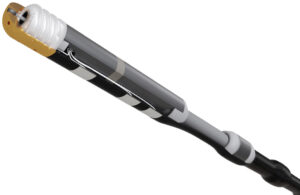
This cutaway illustration shows what’s beneath the surface of the Stereotaxis MAGiC ablation catheter. [Image courtesy of Stereotaxis]
The Stereotaxis MAGiC catheter’s features for ablation
Getting to the target is only the first part of cardiac ablation. The MAGiC catheter has a rounded, gold tip for consistent heart tissue contact during ablation. That contact is “necessary and critical” for both radiofrequency ablation and pulsed-field ablation (PFA) inside the heart, Fischel said.
“What you have with manual catheters is this challenge where you’re trying to create contact between the catheter and the tissue in a beating heart,” Fischel said. “If you think about placing a rigid device on the beating heart, you’re going to have some denting in the tissue, you’re going to have forces between the catheter and the tissue that is volatile based on where you are in the heartbeat cycle.
“If you want to create consistent contact, you have to push a little bit into the tissue,” he later continued. “That pushing introduces the risk that you might have too high of a force at certain points in the heart cycle, and that creates the risk of a perforation.”
The rate of perforation is around 1% even in the most modern manual catheters, Fischel said, but that’s still significant for a major adverse event. To minimize that risk, the Stereotaxis MAGiC catheter has a soft, gentle shaft and is steered directly from the tip.
“When you steer the tip into the tissue, as you start to advance the catheter forward into the tissue, the back shaft buckles at forces typically around 10-20 grams, which is far below what what is typically needed to perforate the heart,” Fischel said. “That’s an intrinsic design characteristic of robotically steered catheters generally and the MAGiC catheter specifically which helps avoid the risk of perforation while ensuring consistent contact with the tissue.”
Related: Cardiac electrophysiologist Dr. Peter Weiss on unmet needs and ablation safety
Fischel declined to name the specific materials in the MAGiC catheter, but said they’re the same as in traditional catheters.
“Other than that, we take out a pull wire and introduce solid magnetic material in the distal end of the catheter and then we use softer durometer plastics and different coils and braidings,” he said.

This closer look at the inside of the Stereotaxis MAGiC ablation catheter shows the helical irrigation fluid channel. [Image courtesy of Stereotaxis]
“Historically, physicians needed to deliver something like 30 mL per minute of saline to the tip to keep the tip cool, and we reduced that by 66% to 10 mL a minute,” Fischel said.
“Many cardiac patients also have renal disorders, and the more fluid you deliver to a patient with renal disease, the more you can have fluid overload and other renal complications,” he continued. “Being able to deliver lesions and to treat these patients without that risk is one of the nice improvements of the MAGiC catheter.”
We’ll have more from Fischel soon on the future of his company’s technology. Be among the first to read more from this interview by signing up for Medical Design & Outsourcing’s free email newsletter.