Synergy Spine CEO Josh Butters explains the implant’s design, materials and a unique feature for safety.

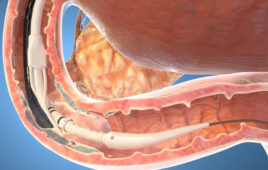
The Synergy Spine Solutions Synergy Disc has a new patented geometry that incorporates alignment and full range of motion. [Illustration courtesy of Synergy Spine]
The startup’s goal was to address a gap in available therapies and engineer an artificial cervical disc that preserves range of motion and improves anatomic alignment after implantation for patients with degenerative disc disease. Synergy Spine founder Dr. Neil Duggal suggested designing the disc like a ball and socket hip joint.
“We were very skeptical on the front end,” said Synergy Spine CEO Josh Butters, a former Stryker engineer. “This concept probably wasn’t conceived initially by an engineer, because an engineer wouldn’t naturally go there.”
More than 17 years after Duggal’s initial design concept, Synergy Spine earned FDA PMA for its Synergy Disc in February 2026.
Following that milestone, Butters explained in a Medical Design & Outsourcing interview how Synergy Spine turned Duggal’s ambitious design into reality by creating new patented geometry and how Synergy Disc was designed for longevity, including a unique feature for safety.
Look for more from this interview on MDO in the weeks ahead. The following has been lightly edited for length and clarity.
MDO: What is the big advance that made Synergy Disc possible?
Butters: “When we were approached with this idea from Duggal, he wanted to create the first generation of a cervical arthroplasty or cervical total disc replacement devices that were essentially a knockoff from a ball and socket hip joint. A hip joint is a great wearing joint. It’s highly congruent and conformal, but it’s really not representative of what the normal spinal anatomy is in your intervertebral disc.
“He brought [our attention to] the unmet need of these first-generation devices. They restored motion, but they did nothing for alignment. Unfortunately, they often made alignment worse. What he wanted to do was create this interrupted articulation surface and have a device that restores alignment and movement.
“Initially, from an engineering perspective, new technology development is always blue sky, but we told him, ‘These things have to wear to be implanted for life. They have to be highly wear resistant.’ There’s a reason it’s a ball and socket. Ball and socket is a great wearing joint.
“We were very skeptical on the front end. This concept probably wasn’t conceived initially by an engineer, because an engineer wouldn’t naturally go there. It requires a person that can think outside that box and identify that need.

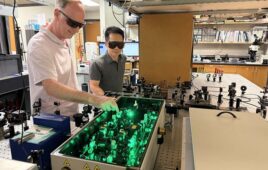
Synergy Spine CEO Josh Butters [Photo courtesy of Synergy Spine]
“We found there was a significantly better material couple and geometry that could really unlock this and that’s how we chose our geometries and materials. At the end of the day, the materials are very conventional and that was part of the secret to our success.
“We’re using titanium and ultra-high molecular weight polyethylene (UHMWPE) that’s been used in orthopedics for probably more than 50 years. In this day and age of cervical discs, novel materials are certainly something that are under a lot of scrutiny. Using time-tested materials really helped us out.”
MDO: Can you speak more about the Synergy Disc’s geometry?
Butters: “It has three pieces. The two gray parts on the top are what we call our end plates and the center is the UHMWPE core. When I’m talking about geometry, it’s really this articulation surface on the top and on the bottom of the core.
“Most of the devices today are just a ball, a sphere. We’ve created a new geometry we’ve patented that incorporates alignment and full range of motion. It’s not a ball and socket. It’s a device that has low energy positions. At rest, it creates an angle that helps to restore a patient’s focal alignment, or focal lordosis at that level.”
MDO: Can you explain a little bit more about the titanium plasma spray coating on the end plates? What does it do? How did that design aspect come to be? Any tips for developers looking to do this in their own field?
Butters: “One of the secrets to great design is to just keep it simple, keep it highly manufacturable. Obviously it has to be unique and it has to have new features, advantages and benefits. But to really take off in the marketplace, it has to have improved clinical performance at a cost that’s the same or even lower. Achieving all those things is very difficult.
“We created a very simple design. It’s very machinable. [The end plates] are machined out of Ti-6Al-4V bar stock in one operation. They machine the backside, pick it off, then machine the other side.
“For the outside treatment of titanium plasma spray, we utilize a company that does this for a lot of the total joint replacements today. It’s a physical vapor deposition (PVD) coating where they spray a plasma layer and then bombard titanium particles on the top. It creates a highly integrated but rough surface texture, and that surface texture enhances the surface area for bone to really grab on to the device. It prevents short-term migration and long-term migration for great short-term and long-term fixation of the device.”
MDO: What was the biggest technical challenge in development of the disc?
Butters: “At the end of the day, it’s really balancing all of the disparate requirements of a device. It needs to be easy to insert, but also you don’t want it to migrate. It has to be cheap to produce, but have better alignment and motion. It’s just balancing all of these things.
“From a manufacturing standpoint, one of the biggest challenges we had was to create a highly polished or surface finish for articulation with titanium. Titanium is not known to be a great material that can polish. We did a lot of experimentation and work with our manufacturing partners to develop a process that gives you a very nice, low roughness average (RA) surface finish that allows for a lifetime of wear for this device.”
MDO: How long did the entire process take?
Butters: “The design was probably done in about three years. From a design concept to testing to manufacturing to first in-human, it maybe took about two-and-a-half to three years. Our first patient was in 2009, so a long, long time ago. The implant hasn’t changed in that entire time. If you can do that homework up front and really test it, try to break it early and make sure you have a solid design, it can last the test of time.”
MDO: What are the safety risks with this particular procedure and how does your design minimize those risks?
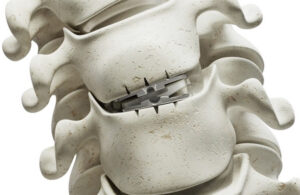
Synergy Spine Solutions designed its Synergy Disc with six fins on each endplate for ease of placement and secure fixation. [Illustration courtesy of Synergy Spine]
“Once the surgeon has done that, they’ll either fuse that segment to restore some kind of normal alignment and stability to that segment, or they’ll utilize artificial discs in that segment.The safety aspect is around the decompression and having great hands and doing that decompression thoroughly.
“Our device is very easy to insert once surgeons complete decompression and size it using trials to find the right size of the device. We offer different lordotic angles so the surgeon can fine tune if they want a 0° or a 6° angle, especially if it’s single or multi-level — we’re not approved yet for multi-level. Then they essentially tap the device in, almost like a fusion cage into the space.
“We have a blend on the outside of our device. Some devices use small teeth, some of the earlier devices use very large keels. We have a hybrid between those two things that we call self-biting fins. It has six fins on both end plates and they pave their own pathway into the bone. The fins make the device easy to insert, very hard to remove. Our fins give the disc good short-term and long-term fixation.
“If there’s one thing about the device that is unique or differentiated around safety, it’s the fins. We also have hard-on-soft, titanium-on-polyethylene stops in every motion plane. So the device can’t disarticulate. It can’t come off like some of the first generation devices.”