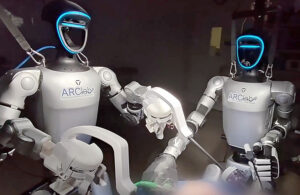
Two teleoperated robots work as a team to perform a laparoscopic gallbladder removal during a pre-clinical trial. [Photo courtesy of UC San Diego-
In a first-of-its-kind procedure, a telecontrolled humanoid assisted a human surgeon in performing successful gallbladder removal on a large, non-primate mammal. A second surgery was performed by two teleoperated humanoids working side by side on a non-primate mammal.
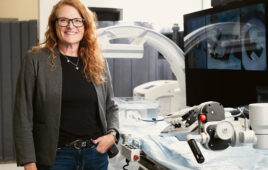
“This study shows that humanoid robots have a viable future in the field of surgery,” said Michael Yip, one of the paper’s senior authors and faculty member at UC San Diego’s Department of Electrical and Computer Engineering.
Register now: The MDO Min-Vasive Medtech webinar series returns Aug. 18-20
Yip and his team said the proof-of-concept study is the first step in introducing humanoids in the operating room to assist physicians during procedures and later perform surgeries while telecontrolled by surgeons, the researchers said.
With a shortage of surgeons and increasing patient needs, healthcare wait times are growing longer and reduced access leads to greater healthcare disparities. Yip said humanoids could help address the disparities gap and expand access to care.
“Remotely operated and autonomous humanoid robots have real potential for amplifying access to critical surgeries to which patients would otherwise not have access,” he said in a news release. “This can help address the healthcare crisis not only in the United States, but also worldwide.”
Unlike surgical robotics systems with specific functionality and indications for use, humanoids are versatile and can be used to perform a variety of procedures and tasks.
“You can imagine these robots being deployed in remote communities where staffing is challenging, or in austere environments like search-and-rescue scenarios where a massive deployment of field medicine is needed in a short period of time,” Yip said.
The humanoids used in the study are 5 feet tall, weigh 60 pounds and feature adapters built by the researchers to hold traditional surgical tools. They’re relatively light and compact, making them useful and accessible in remote, under-resourced areas that can’t build a specialized operating room to accommodate a robotic surgical system, the researchers said.
Surgeons participating in the study said the humanoids fit well in the operating room and controlling the humanoid felt natural.
Dr. Shanglei Liu, who teleoperated with one of the humanoids in the study, told UC San Diego that a procedure performed using a teleoperated humanoid is just as precise as one performed with a teleoperated surgical robotics system.
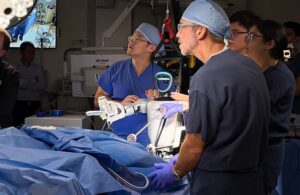
The humanoids used in the study stand 5 feet tall, weigh 60 pounds and feature adapters built by the researchers to hold traditional surgical tools. [Image courtesy of UC San Diego]
While the proof-of-concept study was successful, latency issues were a problem after the humanoids had to be recalibrated several times during the surgeries. As a result, the humanoid procedures took “much longer” than a similar procedure performed with an existing surgical robotic system.
But the researchers see the humanoids in different roles, not just as a surgeon.
“One of our goals is to develop the autonomous surgical assistant,” Yip said.
Those humanoids could perform physical tasks such as grabbing tools for operating surgeons and cleaning up the operating room after a procedure.
“Many communities struggle with adequate staffing on the surgical team, which means patients are not being treated,” he said. “Our goal is an operating theatre of the future, where humanoid robots and humans work side by side as an integrated team to deliver procedures to those in need, both in traditional hospital settings as well as in non-traditional, field medicine scenarios.”
Listen to DeviceTalks Weekly for more on humanoid surgical robots as surgical robotics expert Steve Bell shares his top five newsmakers from the Society of Robotic Surgery (SRS) Annual Meeting.