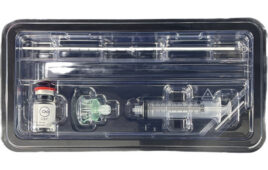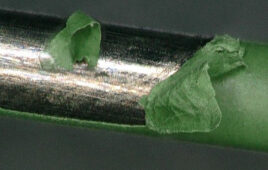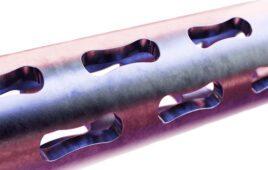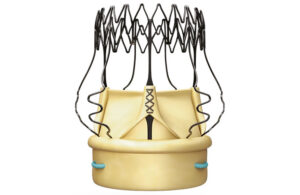
Corcym uses physical vapor deposition (PVD) to apply its Carbofilm coating technology to cardiac implants like its Perceval valves. [Image courtesy of Corcym]
Rather, the company’s implants are black because they’re coated with proprietary technology designed for nuclear reactors and applied using physical vapor deposition (PVD).
Corcym coats its annuloplasty rings and several stents used in cardiac coronary bypass with its Carbofilm technology. It’s a thin film of highly biocompatible pyrolytic carbon that enables “complete endothelialization, prevents inflammatory reaction and scar tissue formation,” according to the company.
“This technology was designed to coat the inside of nuclear power plants because you don’t want that to react with anything outside,” Mazzi said in a Medical Design & Outsourcing interview. “You want this to be totally unreactive. Then somebody said it would make sense to have it in blood because you don’t want your technology to be reacting with anything around blood.”
DeviceTalks 2027 conferences: Registration is now open for DT Boston and DT Minnesota. Interested in speaking? Apply to present.
When Carbofilm was being developed in the 1990s, pyrolytic carbon biocompatibility was well known. But it was a challenge to transfer its hemocompatible qualities to a manufacturable carbon used on biomaterials for medical devices. At the time, established manufacturing techniques affected the turbostratic structure of the carbon, changing its qualities.
Carbofilm’s original developer was Sorin Biomedica, which merged with another medical device company to become LivaNova and later spun out its heart valve business to become Corcym. Sorin Biomedica developed an original manufacturing process that maintained the coating’s hemocompatibility while sticking to the base material. They focused on creating a process to create a thin pyrolytic carbon coating at a very low temperature to avoid affecting the carbon and base material’s properties.
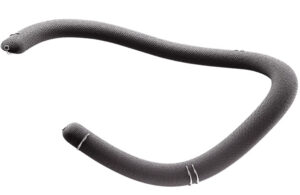
Corcym’s annuloplasty rings are coated with Carbofilm. [Image courtesy of Corcym]
“The reason why we do it is because this particular Carbofilm technology is totally inert,” Mazzi said. “It’s very unreactive to any environment.”
Carbofilm’s high-energy, low-temperature manufacturing process enables the coating of materials like polyester without altering their physical characteristics, according to a Sorin Biomedica study evaluating the carbon and its development.
The thin coating avoids altering the mechanical function of the device while also enabling the carbon to accommodate device movement without detaching, the researchers said. They also said the process guarantees a “high degree of adhesion” between the carbon technology and the base material.
Mazzi said the Carbofilm product can be deposited on any surface at micron-level thickness.
“It avoids any interaction, but also results in a much gentler encapsulation of the technology,” he said. “The rings, you want them to be encapsulated into the body, and that needs to be done in a very gentle way with very little inflammation. That’s what Carbofilm allows us to do.”
2026 Min-Vasive Medtech: Watch on-demand webinar interviews with device development experts offering advice for minimally invasive medical devices and systems