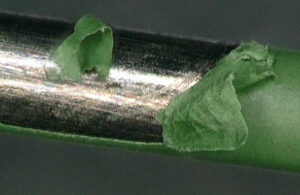
This microscopic image shows PTFE coating delamination on a guidewire sample. [Image courtesy of Aalap Patel]
Every engineering team eventually encounters a qualification result that makes no sense.
A coating passes development testing, incoming inspection and release testing. Manufacturing records look normal. Supplier documentation shows no unusual findings.
Months later, field failures begin to emerge. Investigation teams review manufacturing records, supplier documentation and process controls only to discover that nothing obvious has changed.
The natural assumption is that the failure originated from a manufacturing deviation or supplier issue. Sometimes that assumption is wrong.
One PTFE coating investigation I participated in revealed a different lesson: A coating can pass every adhesion test you designed and still contain a latent failure mechanism that will not become visible until long after the product leaves the factory.
For engineers developing coated medical devices, understanding that distinction can prevent years of frustration and significantly improve verification strategies.
The problem with measuring adhesion at time zero
Most coating qualification programs rely on some form of adhesion testing. Tape tests, peel tests, scratch tests and pull tests are commonly used because they are fast, repeatable and easy to implement. The challenge is that these methods typically evaluate current adhesion, not whether the coating will still adhere after months or years of storage and environmental exposure.
In our investigation, affected lots initially passed adhesion testing after manufacturing. Subsequent testing demonstrated that coating delamination could develop later despite those successful results.
Since this investigation, I no longer assume that a successful adhesion test demonstrates long-term coating reliability. I first ask whether the qualification strategy challenges the degradation mechanism I am most concerned about. Passing a tape test confirms current adhesion strength. It does not necessarily prove long-term adhesion reliability. When qualification programs focus exclusively on initial performance, latent degradation mechanisms can remain hidden.
What the investigation revealed
The most interesting finding was that the failure was latent. Early testing showed that delamination was not limited to a single manufacturing lot, raw material batch, substrate size or coating date. Multiple product families exhibited similar behavior despite being produced at different times and under different manufacturing conditions. That observation immediately challenged the traditional assumption that a specific manufacturing excursion had caused the problem.
Detailed analytical testing eventually identified a consistent characteristic associated with severe delamination: an interfacial layer rich in phosphorus, chromium and oxygen located between the substrate and PTFE coating. The layer was present in failed samples and absent in comparable non-failed samples. Delamination repeatedly occurred within that microscopic layer.
More importantly, standard release testing had not detected the mechanism. Looking back, the degradation mechanism was present from the beginning. What changed was our ability to expose it. The qualification program was measuring adhesion strength, not the environmental conditions that gradually reduced it.
Humidity exposed what accelerated aging missed
Like many medical device programs, accelerated aging studies were part of the overall qualification strategy. However, elevated temperature alone was not sufficient to reproduce the failure mechanism. The breakthrough came when the investigation team began evaluating the impact of humidity.
Samples exposed to elevated humidity and temperature developed the same delamination characteristics observed in field-aged products. The resulting failures displayed the same interfacial features and failure morphology as naturally aged samples.
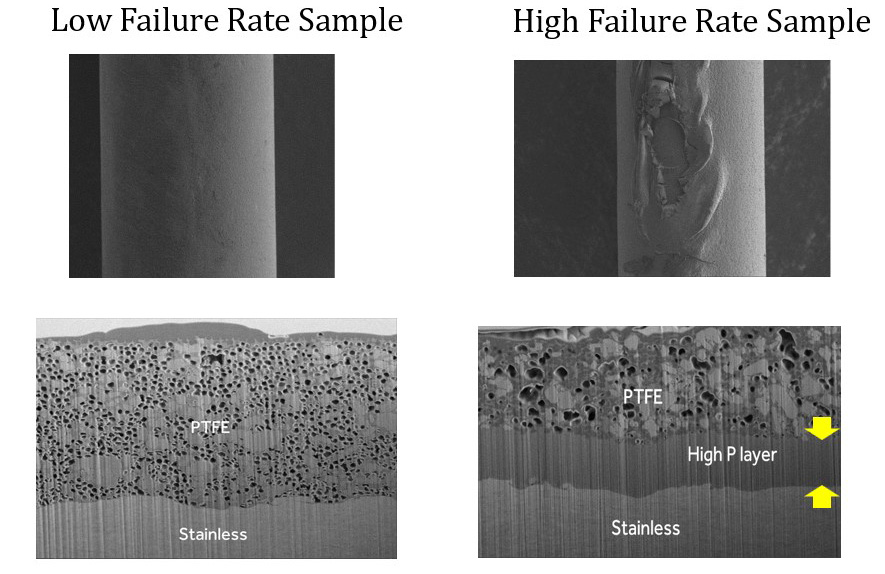
These interfacial SCM images compare low and high failure rate samples. [Image courtesy of Aalap Patel]
If not, the absence of failures may provide a false sense of confidence.
Five ways to avoid this mistake
Engineers evaluating coating systems should consider the following practices:
- Separate adhesion strength from adhesion reliability: A coating can have excellent initial adhesion and poor long-term durability. Evaluate both independently.
- Build tests around failure mechanisms: Start by identifying plausible degradation pathways, then design tests specifically to challenge them.
- Characterize the interface: Failures often occur at microscopic interfaces rather than within the coating itself. Analytical characterization can reveal risks that mechanical testing cannot.
- Challenge environmental assumptions: Do not assume temperature is the only relevant aging factor. Humidity, packaging conditions and environmental exposure may play a significant role.
- Investigate patterns, not just lots: When failures appear across multiple lots, products, or manufacturing dates, consider whether a common latent mechanism may be present.
As coated medical devices become increasingly sophisticated, engineers must move beyond asking whether a coating passes a test and start asking whether the test challenges the mechanism most likely to cause failure.
Qualification testing will always be limited by the questions engineers choose to ask. If the qualification strategy never challenges the mechanism most likely to cause failure, a passing result may simply confirm that the wrong question was asked.
That’s the lesson I carried forward from this investigation, and one that continues to influence how I evaluate coating reliability today.
Aalap Patel is a MiniMed engineering manager with more than 15 years of experience in medical device design quality, post-market engineering and failure investigations for Class II and Class III devices. His work focuses on developing and validating processes and test methods, investigating complex failure mechanisms and improving product reliability through risk-based engineering approaches.
Read more MDO Contributions and learn how to submit your own.
The opinions expressed in this blog post are the author’s only and do not necessarily reflect those of Medical Design & Outsourcing or its employees.


Tell Us What You Think!
You must be logged in to post a comment.