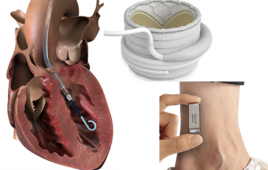
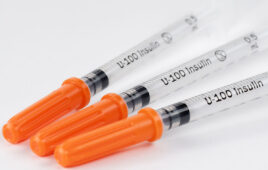
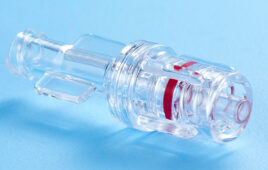
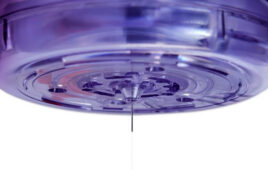
Medtronic’s MiniMed 780G system includes a smartphone app, an infusion set, MiniMed 780G pump and a Guardian 4 sensor. [Image courtesy of Medtronic]
“To go from that to where we are now, where the majority of the insulin is fully automated by the system … that was just a radical technology shift,” Lintereur said.
Lintereur is now Medtronic’s chief engineer for the MiniMed 780G and MiniMed 670G automated insulin delivery systems. MiniMed 670G was the first step toward a hybrid closed-loop system for Medtronic, with part automated insulin delivery and part manual delivery.
With insulin delivery, patients receive basal insulin doses, bolus doses and meal boluses. Medtronic designed 670G to automate one of three with the basal insulin, leaving the boluses to the user.
Medtronic went a step further with the newer 780G, automating the basal and the boluses. If a user ate more than they anticipated or didn’t know how many carbohydrates were in their meal (or even if they forgot to bolus altogether), MiniMed 780G can introduce automatic correction boluses.
The latest-generation system also introduced glucose target options for patients, offering a lower target setpoint option. With 670G, patients had a one-size-fits-all target of 120 milligrams per deciliter. Now, with 780G, they can go as far down as 100 milligrams per deciliter.
Adding a long-term infusion set
An extended infusion set is a key differentiator for Medtronic’s latest insulin pump technology. This set can last up to seven days, more than double the standard wear time of insulin pump infusion sets — halving how often patients need to insert the infusion set’s needle into their skin.
“No one likes to do that, so we radically reduced the time that people would have to do it,” Lintereur said.
There’s also an environmental benefit. The longer-lasting infusion sets result in half as much plastic and other packaging waste ending up in landfills.
To develop the infusion technology, Medtronic investigated why standard sets only lasted two or three days. The root cause, they found, was related to the insulin, Lintereur said. Effectively, the insulin wears out the infusion set.
Insulin in a pump is shaken as it moves into the body, he explained, but as the user agitates the insulin the preservative erodes over time. This results in insulin plugging up the infusion set, eventually to the point where insulin can’t be absorbed at all and the user has to replace the set.
Medtronic found ways to slow the rate of insulin aggregation by changing materials within the tubing. The company also created a capturing mechanism within the set that can capture aggregated insulin to prevent it from wearing down the set.
“It’s that combination of preserving the insulin and preventing the aggregated insulin from getting in,” Linteurer said, though he declined to divulge proprietary details about the technology. “That’s what has allowed us to make this big technology leap to a seven-day set.”
Building trust in new diabetes technology

Medtronic MiniMed Chief Engineer Lou Lintereur [Photo courtesy of Medtronic]
One of the hardest things to do as a control engineer is to develop a deep knowledge of the thing they’re trying to control, Lintereur said — in this case, human physiology around diabetes. Medtronic needed mathematical precision to develop a safe and effective system.
“We take the human physiology and create a mathematical model that describes how it works,” he said. “Developing that level of understanding was one of the main technology hurdles. … Dosing insulin appropriately is actually almost the easier part of the problem. Developing that mathematical understanding of the thing you’re trying to build is the harder part.”
Medtronic then had to get physicians and patients to adopt the new technology.
“Before, they had complete control over all the insulin that went into their body, and now they’re going to have to trust this algorithm and a sensor that they really have no reason to trust,” he said. “[And it’s] not just the patients, but the health care providers prescribing these technologies and getting them to understand how these systems work and to build their trust. Even outside of the technology, there’s lots of areas we needed to innovate on to roll this out.”
Medtronic introduced a shield icon in the user interface of the 670G to tell the patient when the system was delivering automated therapy.
“Presenting unambiguous images on the user interface and messaging to the user to indicate when they have control versus when the machine has control, that was something we had to really carefully think about and design into the system,” Linteurer said. “… It’s now become almost an iconic image in diabetes therapy.”
Ongoing challenges
Medtronic’s mathematical models are much better than they were 10 years ago, but still have room for improvement, Linteurer said.
Another continuing challenge is one that control engineers commonly confront: balancing automation with user control.
“When you have a control system that has a human-machine interface where the human has to do some things to participate with the therapy, and the machine has to do things and participate with the therapy — certain things that human’s responsible for, and other things the machine’s responsible for — where do you draw that line, and how do you make it seamless so the user and the machine can’t fight with each other?” Linteurer said. “… Navigating that human-machine interface and finding that right balance of how much do we want to be automated versus how much do we want the human to remain in control is also a big challenge for us and something that we’re constantly having to evaluate rebalance as we push further into automation. It’s a moving horizon.”
Solving that challenge starts from the actual capabilities of technology at their disposal. With the first generation system, Medtronic’s team knew that all they could do is automate the basal insulin. But they anticipated some situations where patients wouldn’t want to use the automation if it’s not working well for them or they couldn’t use the automation because they didn’t have a sensor.
“It’s working through different scenarios — when a user might want to take control versus turning the control over to the the algorithm, and then finding a way to make it crystal clear to the user that now they are in the automated mode, or now the algorithm is is is turning it over to the manual control,” Linteurer said.
Making that crystal clear to the patient — a goal of the shield icon, for example — avoids confusion about the system’s control, which could lead to mistakes and safety problems.
“We’re looking at technologies to automate even more of the insulin going forward,” he said. “It’s a moving line, that boundary in that human-machine interface. That continues to be a big challenge for us.”