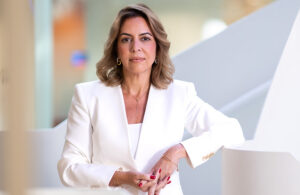
Philips Chief Medical Officer Dr. Carla Goulart Peron [Photo courtesy of Philips]
“As a woman in the business, if we don’t take the lead here or the leadership position, somebody else will,” Peron said in a Medical Design & Outsourcing interview. “We need to shape what the future will look like and not just be waiting for big techs to do that by themselves.”
She says artificial intelligence will be a big part of it.
“It’s going to empower voices out there. It’s already happening, but we need to keep pushing,” she said. “Resiliency is a big word here, because we need to keep pushing and reminding people that we cannot go backwards.”
The following has been lightly edited for space and clarity.
MDO: Can you share more about your role at Philips?
Peron: “I’m the chief medical officer for the company. My role is to support the company from the clinical medical perspective, and to do that, I’m leading a group of physicians and clinicians in different specialties that are responsible for all the clinical research work that is required to be executed for us to make sure that we have safe and products that are performing as intended. I also lead a group called Med Safety. It’s the team that assesses risk-benefit and makes sure that we do everything that we can to mitigate any potential residual risk. We are healthcare. We need to be very thoughtful about how the products are performing. I also have a group that is dedicated to what we call healthcare economics and reimbursement, which is an arm dedicated to making sure that once we have a technology that fulfills all the regulatory requirements from the FDA, for example, it can actually be commercialized and used by clinicians in the U.S. You also have the reimbursement piece in place, so that you have the ability to have code coverage policies and reimbursement for the technology to be fully adopted. It’s a very important group. It is a group of approximately 400 people supporting all business units at Phillips in different capacities.”
Related: Read our September 2026 issue: The MDO Medtech Big 100 breaks $500 billion
How do you guide strategic direction?
Peron: “Understanding the unmet needs in healthcare in different areas. The team that is under me has different specialties. We have interventional cardiologists, we have electrophysiologists, we have neurologists, ICU doctors; different areas of care, engaging with the R&D organization and also engaging with our partners because we don’t want to develop technology for the sake of technology, but develop for what we are missing to offer better care for more patients on the planet. We are working head-to-head with R&D, with our marketers and business unit leaders to define what’s coming next on our roadmap.”
How has Philips’ strategic direction changed since you’ve been in your role? What are you focused on right now?
Peron: “When I first joined Philips, it was really about building that infrastructure from the managerial and clinical perspective. Philips has been around for 135 years. We’re actually celebrating that anniversary right now of being a very solid company in the technology space. It started in healthcare a long time ago, and most recently — in the last decade or so — we’ve shifted our focus to healthcare and wellbeing. The first two years were about building that capability and expanding the capacity to drive growth for the future, which is where we are right now. We shifted a lot from building that infrastructure to driving what’s coming next, specifically in the cardiovascular space, on stroke. I am personally very passionate about women’s health, and how big the gap is between being female or male in the cardiovascular space. Those are the areas that we’re investing in at Philips right now.”
Related: How Philips and Disney are improving children’s MRI experience
As a healthcare professional and an executive, how do you approach these solutions?
Peron: “As a physician, what always comes first is the patient. Patient centricity needs to be what drives our decisions, but to impact that patient, you need to make sure that all other stakeholders are part of the conversation. In order to provide the best care for patients, you need to make sure that the payers, providers, clinicians, nurses, healthcare workers and government, sometimes, are being incorporated into understanding unmet need and how we adopt technology — but we also need to see that through the lens of the business. That’s the biggest shift when you go from being a physician in a one-on-one setup, seeing patients, which is basically how I do my best for that patient that I’m seeing in front of me, to how you learn to translate those skills into something that makes sense for a corporation like Philips. Being an executive at the table, being capable of speaking finance to investors, and how you talk to the regulators is as important as understanding what the specific patient needs. Solutions need to be scalable to reach a point where it makes sense from the company’s perspective, so we need to find that middle ground between doing the best to impact patients to the best of our capacity and making sure that the company and the entire chain of command can benefit from it.”
How can technology be a patient’s advocate and provide patients with decision-making tools?
Peron: “There are three things that AI will help us to transform. It’s already happening. The first one is creating transparency. We did have data in many different places, we just didn’t have access to it. Now we do, in a much faster approach. The second thing is the ability to get that data longitudinally, understanding the potential impact. The third piece is that AI will enable us to do things faster and in a different way that will free up time for us humans to focus on what matters most. We’re merging.
“If you think about healthcare overall, in the last 20 years we saw a big shift from one-on-one time with the patient, taking care of that patient, and a shift into bureaucratic reports, documenting things [and] the ability to process all the information that has been published. It takes a lot of time. AI can put this in front of us very quickly. It’s a merge between our human capacity and machine learning that will make us better. That’s how I see AI playing a role. It’s a lot of potential. We need to realize that potential, and it requires a lot of courage: being bold, taking risks, learning fast with errors, making mistakes and improving fast. This is going to be the future of healthcare.”
Where do you see healthcare in the next five years?
Peron: “The next five years will be about how we learn to merge. I truly believe that this is a merge. We can be better if we rely on AI, but it needs to be done with a trusting approach. If we don’t have a very scientific, robust process behind it, it will create a lot of skepticism and distraction, and then people get concerned about adopting it. In the next two years, we need to find a way to build trust among all the players: regulators, users, patients. A lot of patients — and we are doing surveys internally at Philips — are very much concerned about losing that human touch. They don’t want to be talking to the machine, they want to talk to their physician. But how much time are you getting from your physician? Maybe if he or she can get a little bit of free time from other bureaucratic things that AI can take over, the ability to interact with you better will come to fruition. I personally believe that we’ll be able to impact a lot more patients with the same infrastructure. That’s my goal. That’s what access to care means to me. AI will democratize access to healthcare overall by taking the treatment or the diagnostics to where the patients are, rather than bringing them to the hospital — we talk a lot about home as a hub — or by bringing the patients and the physicians, wherever they are, into that reality in small healthcare environments or point of care. That’s what’s going to happen in the next five years. We are going to be seeing healthcare access being democratized by the ability to have access to data and AI-enabled tools.”
How do medical device developers address AI biases, and how do you get patients to trust this technology?
Peron: “We are in a process, that’s the reality. All of the companies are getting deeper and deeper into how we develop AI in a way that this can be trusted by regulators, trusted by the users and trusted by the patients that are going to benefit from it. The only way of doing this is making sure that your data set is very well identified and defined and that it incorporates the population that you intend to use. You cannot test something in the U.S. only and then think that this will fit in Japan or in Singapore, or in India. You also need to make sure that you were testing your model to the best of your capacity on a different data set than the one you used to train the model. That’s how you build trust among physicians and regulators. This is not easy to do. That’s why partnership is so important, because in order for you to use that large data set, you need multiple partners from different geographies and that’s why partnering with healthcare providers is so important for Philips in this specific scenario. That’s going to be reality for all companies that are developing in that space. You need to be able to get different patient populations and nuances, making sure that you are stratifying the data properly. I am a big advocate for women’s health, making sure that you have good distribution between female and male data. Pediatrics is another big challenge for most companies worldwide. It’s making sure that you have a very rigorous scientific methodology as you are developing, training and validating your AI solutions.”
How is Philips diversifying the patient population in clinical trials?
Peron: “There are a lot of discussions around how do we reduce that gap. The clinical trial piece is one of those. You also need to make sure that you are getting input from the physiology perspective from the get-go, the differences between female physiology and male physiology. At Philips, we have goals to make sure that the population is representative of the intended use of the technology that we are developing. It’s not about saying it’s 50/50 because it may not be the case. Sometimes it will be more predominant in males, then we need to have more males in that clinical trial patient population. Sometimes it’s more predominant in females, then we need more females in that clinical trial patient population. Applying scientific rigor is critical.
“I’m personally making sure there is awareness and attention for that, and that we can actually leverage every single opportunity out there. Philips is not a women’s health company by itself because we serve the totality of the population, but if you think about the gap, there are a lot of opportunities where we can still grow in the cardiovascular space. One of our top priorities is addressing the gap that we have specifically for females, and this is a win-win, because patients will benefit from that, women will benefit from that, and there are a lot of opportunities to be unlocked from the business side. That’s how you push for change. You show where the benefit sits from the business perspective as well.”
Why wasn’t this done before?
Peron: “It’s awareness. Unfortunately, we as women didn’t necessarily have a voice. We’re still not at the stage that I would like us to be, and I truly believe we need more people advocating and making sure that this goes from ‘okay, we didn’t know’ in the past, to ‘now we know, what are the next steps.’ How do we make sure we have the right input? That we are thinking about this through the lens of the patient population? The reason I keep repeating this is that women’s health cannot be seen as a niche. We represent more than 50% of the overall global population and we are not men; our physiology is different. Having a technology that sits within those nuances is going to be a successful story for the patients we serve, the hospitals using the technology that are serving those patients, and for the business. It is truly a win-win. Only when we make this very transparent and clear that this is not a niche: ‘Oh, let’s include women because they deserve.’ No, we represent 50% more than 50% of the population. If we are incorporated from the get-go, our technology is going to be better.”
What advice would you give to young women?
Peron: “Be intentional. Sometimes, at least in my culture, where I was born and raised, you are taught to be quiet, just do a good job and somebody will realize that you have done a good job. That doesn’t work in business. Be intentional. Tell people where you want to go, ask for help, accept the help and push.”