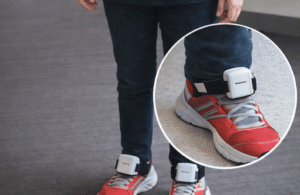
Strapped to each foot, the researchers used Shimmer3 wearable inertial measurement unit (IMU) sensors to track walking speed, stride length and steps-per-minute. [Photo courtesy of the JMIR paper authors]
Led by researchers at Yale University, the paper published in JMIR Formative Research found that wearable tech was nearly perfect in matching readings of a person’s walking speed, stride length and steps per minute.
“The technical agreement we saw between the foot-mounted sensors and the laboratory motion capture system was exceptionally strong,” said first author Charles Odonkor, associate professor of orthopaedics and rehabilitation at Yale School of Medicine, who described the wearables as “on par with the expensive camera systems that require a dedicated lab space.”
Clinicians typically use scheduled evaluations, X-rays and potentially inaccurate self-reported surveys to track the progression of painful and chronic knee osteoarthritis, but this does not offer a clear picture of the patient’s movement in their daily life.
The researchers recruited 20 participants for the study, including 10 with osteoarthritis in the knee. Each completed a self-paced walking test, a fast-paced test and a six-minute endurance walk in front of the lab’s cameras while wearing small inertial sensors to record their feet’s acceleration and rotation.
They found patients who reported higher levels of daily activity walked faster and took longer strides, while those who described themselves as inactive spent more time with their feet flat on the ground during a step, and showed differences in how their feet pushed off the ground.
“While our focus was device validation, these insights into physical activity give us a glimpse of what wearable technology might achieve,” said Odonkor. “We saw that sensors can pick up subtle changes in walking rhythm among less active individuals, which opens the door to tracking functional declines before they become severe clinical concerns.”
The researchers said future studies would need to be larger and longer, as well as follow participants home as they wear the sensors to provide an objective view.