Medical Design and Outsourcing

  • Home
  • Medical Device Business
    • Mergers & Acquisitions
    • Financial
    • Regulatory
  • Applications
    • Cardiovascular
    • Devices
    • Imaging
    • Implantables
    • Medical Equipment
    • Orthopedic
    • Surgical
  • Technologies
    • Supplies and Components Index
    • Contract Manufacturing
    • Components
    • Electronics
    • Extrusions
    • Materials
    • Motion Control
    • Prototyping
    • Pumps
    • Tubing
  • MedTech Resources
    • Medtech Events in 2026
    • The 2025 Medtech Big 100
    • Medical Device Handbook
    • MedTech 100 Index
    • Subscribe to Print Magazine
    • DeviceTalks
    • Digital Editions
    • eBooks
    • Educational Assets
    • Manufacturer Search
    • Podcasts
    • Webinars / Digital Events
    • Whitepapers
    • Voices
    • Views
    • Video
  • 2026 Leadership
    • 2025 Winners
    • 2024 Winners
    • 2023 Winners
    • 2022 Winners
    • 2021 Winners
  • Women in Medtech
  • Advertise
  • Subscribe

Ray Cohen sizes up the renal denervation market after $600M SoniVie sale

November 6, 2025 By Jim Hammerand

After selling SoniVie to Boston Scientific for $600 million, Ray Cohen discusses competition in the RDN market and what will win physicians over.

A photo of Ray Cohen.

Ray Cohen [Photo courtesy of Andera Partners]

Ray Cohen put another big number on the scoreboard since the first part of our interview with one of medtech’s most successful leaders.

The day after his Oct. 17 keynote at our DeviceTalks West show in Santa Clara, California, Boston Scientific announced a $533 million deal to purchase Nalu Medical.

Boston Scientific had already been a strategic investor in the minimally invasive chronic pain device developer since 2017. Cohen became chair of Nalu’s board in April 2025 after selling neuromodulation developer Axonics to Boston Scientific for $3.7 billion in 2024 and striking a deal in March 2025 to sell renal denervation (RDN) developer SoniVie to Boston Scientific for up to $600 million.

We interviewed Cohen in September ahead of the announcement that he joined Resonant Link Medical’s board as chair, and used the opportunity to ask for advice he would share with other device developers.

In this next part of the series, we discuss RDN, which could help hundreds of millions of people with hypertension manage their blood pressure with minimally invasive catheter procedures.

“RDN works, and the clinical results are showing patients’ reductions in blood pressure continue to go down over time,” he said.

In 2012, Cohen was CEO of another RDN developer, Vessix Vascular, when it sold to Boston Scientific for up to $425 million. That price was contingent on Vessix hitting clinical- and sales-based milestones, but failed trials prevented RDN developers from winning FDA approval until 2023.

That year, Otsuka’s Recor Medical and Medtronic both won FDA approval for their RDN systems, though Cohen said Recor’s clinical trial success likely helped Medtronic overcome its failed trial.

The following has been lightly edited for length and clarity.

MDO: What’s special about SoniVie?

A photo of Boston Scientific's SoniVie Tivus renal denervation (RDN) catheter.

Boston Scientific’s SoniVie Tivus renal denervation (RDN) catheter [Photo courtesy of Boston Scientific]

Cohen: “SoniVie’s product is differentiated because it’s high-frequency ultrasound and the probe does not touch the renal artery. It just swims in the middle of the artery and blasts the energy from there, so no deleterious effect inside the artery. Ultrasound is different than radiofrequency (RF), more powerful than RF, and doesn’t leave any damage inside the artery. The Medtronic device is a point-and-shoot device, so the physician has to manipulate inside the renal artery. It takes a long time to complete the procedure using their approach. It’s not the ideal embodiment in my view.”

[Editor’s note: In a response, Medtronic says Cohen appears to be discussing Medtronic’s earlier Symplicity Flex catheter rather than the FDA-approved Symplicity Spyral. We followed up with Cohen before publication to ask which catheter he was referring to, but he declined to say.]

“With SoniVie you’re in, you’re out, and a minute later you’re done with the denervation on one side, go to the other side and you’re done. The technology gives depth of penetration, and the fact that you’re swimming in the arteries means you don’t need cooling. The blood will cool the heat coming off that probe. Recor puts their ultrasound probe in a balloon, and that’s a little trickier. At Vessix we developed a balloon-based product, but the electrodes were on the exterior of the balloon as opposed to something inside the balloon. So you would inflate the balloon, make opposition to the wall, energize for 30 seconds and then you were out. That still is a winning embodiment. Unfortunately, it got mothballed because of the Medtronic disaster a decade ago.
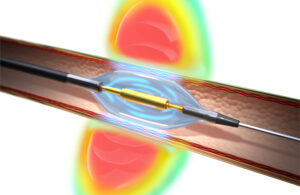
An illustration showing the Recor Medical Paradise ultrasound RDN system's balloon catheter ablating nerves in the walls of the renal artery.

The Recor Medical Paradise ultrasound RDN system uses a balloon catheter for 360-degree sonication to ablate nerves in the walls of the renal artery. [Illustration courtesy of Recor Medical]

“Recor — right now in terms of what’s approved — they’ve got the best product, the best embodiment.  Medtronic is going to start the market. They’re going to get the most revenue at first and we’ll see how it goes from there. Boston’s got to complete the pivotal study and get the damn thing approved and get in the market, so unfortunately they’re going to be third into the marketplace.”

Related: What Medtronic learned on its long road to RDN approval

MDO: What do you think is going to be the big differentiator in RDN when physicians are choosing one system or the other? Is it going to be energy modality, usability, the clinical trial results? I’m sure you watched that FDA review panel as well as I did for Medtronic and Recor before resulting FDA approvals for both.

Cohen: “Medtronic would not have gotten approved if it wasn’t for Recor. … It’ll boil down to efficacy and how much time does it take to execute on this procedure. Physicians don’t get time-based payments. They get the payment for the procedure.

“You can tell how well renal denervation works pretty quickly, although it does get better over time, which is the irony of all this. A year out, you’re going to get a better reduction in blood pressure than when you first get the procedure. You’re affecting the communication of the nervous system to the brain and if you have been alive for a period of time, that’s been wired that way for decades. Younger people get an immediate, robust response, while older people get a decent response that gets better over time. It’s just an observed phenomenon. You’re not going to know the answer on day one to this question. It’s going to be a matter of how well ultimately does it work, and then support is part of the puzzle. In other words, do you have good people out there supporting the procedures?

“It’s going to take a couple years to settle out, but I do believe it’s a billion-dollar business within the first couple of years. It’ll grow very, very fast. Medtronic is talking about $400 million in 2027 for the first full year of reimbursement. I don’t like their product, but I don’t think they’re crazy in terms of what the uptake will be.”

Related: RDN ‘could be the biggest thing we ever do,’ Medtronic CEO Geoff Martha says

MDO: Are there any big, unanswered questions in RDN right now about safety?

Cohen: “A lot of people have been treated, and a lot of people were treated a long time ago. Thousands of patients were treated 13, 14 years ago and then throughout this period of time. If there were problems that were latent, you’d know about it, and there has not been any. Unfortunately, because there’s been different embodiments and different clinical results, there’s a little skepticism about how well it works.

“Efficacy has been shown to be pretty good. And if you can get off those damn blood pressure medications or if you can reduce them significantly — particularly for the male population, because the side effects of blood pressure meds are erectile disfunction and and weight gain — with a 30- or 45-minute outpatient procedure and it’s minimally invasive with nothing being left behind, why wouldn’t you? I don’t think you’re going to get reluctance from the patient population. What ultimately needs to be resolved is how are patients going to get to the interventional cardiologist to get the procedure done? … I think it’s going to be one of the biggest devices in the history of our business. Will that happen right away, in 2027? Probably not, but it’s got a lot of room to run, and I’m really bullish about it.”

Related: How alcohol could make renal denervation for hypertension faster and simpler

MDO: How much room is there for competition in RDN?
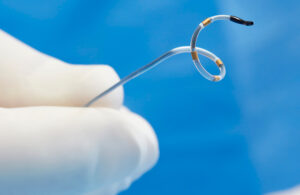
A photo of Medtronic's Symplicity Spyral renal denervation catheter with a gloved hand for scale.

Medtronic’s Symplicity Spyral renal denervation (RDN) ablation catheter expands inside the renal arteries to apply energy that calms overactive nerves that help regulate blood pressure. [Photo courtesy of Medtronic]

Cohen: “There will be ankle-biters that will come around once the market starts. But who cares? There’s going to be three players in this market — Otsuka’s Recor, Medtronic and Boston Scientific — and with three major players, how much room is there going to be? It’s kind of like spinal cord stimulation: Abbott (the St. Jude product), Medtronic, and Boston Scientific. Nevro tried but didn’t quite get there. There’s got to be at least six ankle-biters, but probably 85 to 90% of the business is held by those four players, and I would argue 80% of the business is held by three players. Why would anyone want to enter as the fifth man in a four-man race?”

For more from this interview with Cohen, including what he views as the key to his success and how medtech should respond to the Trump administration, sign up for our free email newsletter and watch for the next article.

About The Author

Jim Hammerand

Jim Hammerand is the managing editor of Arrowfly's Medical Design & Outsourcing, where he leads coverage of medtech innovation, design, engineering and manufacturing. He also reports breaking news at Arrowfly's MassDevice and contributes to our DeviceTalks podcasts and live events. Hammerand has more than two decades of journalism experience spanning newspapers, magazines, websites, live events, radio and TV news. For nearly a decade, Hammerand reported and edited business news for American City Business Journals as a reporter and digital editor at the Minneapolis/St. Paul Business Journal and then as managing editor of the Puget Sound Business Journal in Seattle. He holds degrees in journalism and management from the University of Minnesota and has won journalism awards from the Society of Professional Journalists, American Society of Business Publication Editors, and Trade, Association, Business Publications International. Connect with him on LinkedIn or by email at [email protected].

Related Articles Read More >

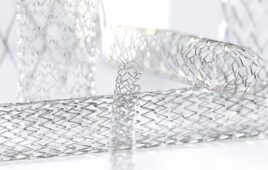
A photo of nitinol, a nickel-titanium alloy used for medical devices such as stents, heart valves, catheters and orthopedics.
What is nitinol and where is it used?
An illustration depicting the Nephrodite Holly implantable system for continuous dialysis.
FDA picks Nephrodite’s implantable dialysis system for TAP pilot
A cutaway illustration showing what's beneath the surface of the Stereotaxis MAGiC catheter.
Stereotaxis designed the MAGiC cardiac ablation catheter for consistent and safe tissue contact
A sphere-shaped, expandable lattice device with electrodes for cardiac ablation
Medtronic tech takeaways on PFA, RDN, M&A and R&D from top executives
“mdo
EXPAND YOUR KNOWLEDGE AND STAY CONNECTED
Get the latest medical device business news, application and technology trends.

DeviceTalks Weekly

See More >

MDO Digital Edition

Digital Edition

Subscribe to Medical Design & Outsourcing. Bookmark, share and interact with the leading medical design engineering magazine today.

MEDTECH 100 INDEX

Medtech 100 logo
Market Summary > Current Price
The MedTech 100 is a financial index calculated using the BIG100 companies covered in Medical Design and Outsourcing.

New MedTech Resource

Medical Tubing

MassDevice

Mass Device

The Medical Device Business Journal. MassDevice is the leading medical device news business journal telling the stories of the devices that save lives.

Visit Website
MDO ad
Medical Design and Outsourcing
  • MassDevice
  • DeviceTalks
  • MedTech100 Index
  • Medical Tubing + Extrusion
  • Medical Design Sourcing
  • Drug Delivery Business News
  • Drug Discovery & Development
  • Pharmaceutical Processing World
  • R&D World
  • About Us/Contact
  • Advertise With Us
  • Subscribe to Print Magazine
  • Subscribe to our E-Newsletter
  • Listen to our Weekly Podcasts
  • Join our DeviceTalks Tuesdays Discussion

Copyright © 2026 Arrowfly, LLC. All Rights Reserved. The material on this site may not be reproduced, distributed, transmitted, cached or otherwise used, except with the prior written permission of Arrowfly LLC. Site Map | Privacy Policy | RSS

Search Medical Design & Outsourcing

  • Home
  • Medical Device Business
    • Mergers & Acquisitions
    • Financial
    • Regulatory
  • Applications
    • Cardiovascular
    • Devices
    • Imaging
    • Implantables
    • Medical Equipment
    • Orthopedic
    • Surgical
  • Technologies
    • Supplies and Components Index
    • Contract Manufacturing
    • Components
    • Electronics
    • Extrusions
    • Materials
    • Motion Control
    • Prototyping
    • Pumps
    • Tubing
  • MedTech Resources
    • Medtech Events in 2026
    • The 2025 Medtech Big 100
    • Medical Device Handbook
    • MedTech 100 Index
    • Subscribe to Print Magazine
    • DeviceTalks
    • Digital Editions
    • eBooks
    • Educational Assets
    • Manufacturer Search
    • Podcasts
    • Webinars / Digital Events
    • Whitepapers
    • Voices
    • Views
    • Video
  • 2026 Leadership
    • 2025 Winners
    • 2024 Winners
    • 2023 Winners
    • 2022 Winners
    • 2021 Winners
  • Women in Medtech
  • Advertise
  • Subscribe